
The thing about manufacturing that people outside the industry often don’t understand is that it’s not binary—either everything automated or nothing automated.
Let me explain what happens after those wheels are successfully attached to the main body. At that point, the runner still isn’t complete. It’s not yet functional. The ball bead connector still needs to be inserted into the runner channel. When that bead is seated correctly in its groove, that’s when the runner becomes a functioning product—that’s when it can slide smoothly on the track and do its job. That’s when your customer can actually use it to hang their curtains.
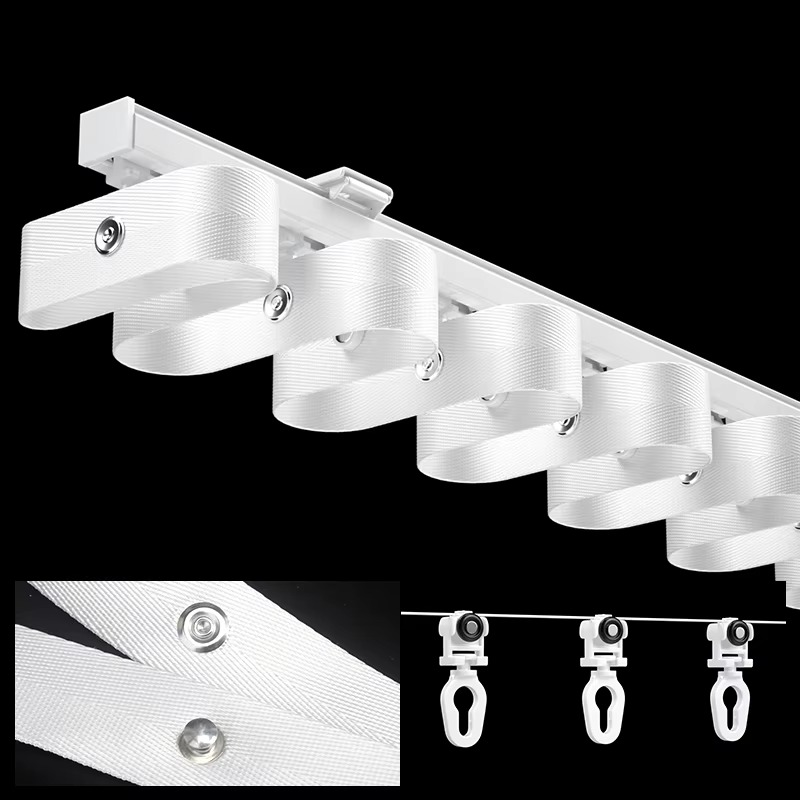
This insertion stage is critical. If the bead is inserted too loosely, the whole assembly rattles and doesn’t function properly. If you force it in too hard, you risk cracking the plastic housing or misaligning critical components. This isn’t the kind of work where you can just program a machine and walk away. You need feel. You need judgment. You need experience. This is exactly the type of work where our most experienced workers outperform machines. They know exactly how much pressure is right. They can sense when something isn’t aligned correctly and adjust it immediately.

Consider who we’re selling to: factories that buy aluminum curtain runners wholesale need consistency. They’re going to resell these products. Every single unit has to perform the same way. Commercial projects that require heavy duty curtain runners demand reliability and precision. These aren’t small orders we’re talking about. These are large volume orders where quality failure multiplies across hundreds or thousands of units. If we compromise on the insertion step, that directly impacts product performance in the field.
Our quality control process catches defects at the source because our experienced workers are directly involved in production. Our workers performing the bead insertion see things that a fully automated system would miss. Maybe a wheel isn’t seated completely. Maybe there’s a minor plastic deformation. Maybe the alignment is off by a fraction of a millimeter. These experienced workers detect these issues in real-time and correct them right there on the line. That’s impossible with pure automation. A machine can’t make those judgment calls. It just runs its program and produces output.

This becomes especially critical when we’re producing heavy duty curtain runners. The specifications are tighter. The bead insertion has to be perfect. The wheel alignment has to be flawless. The materials have to be premium grade. You cannot compromise on any of these factors and still have a product that legitimately qualifies as “heavy duty.” This is precisely why we keep our most skilled workers involved in every stage of heavy duty runner production. Commercial installations depend on this reliability.
When you’re looking to buy curtain runners from China, you need to understand what you’re actually purchasing. Some factories will claim everything is fully automated because they think that sounds impressive and modern. But what does full automation mean if the quality doesn’t hold up? What’s the point of automation if product defects reach your customers?
Our philosophy is different. We automate intelligently—where it makes sense and where it improves efficiency. We keep skilled people involved where it matters most for quality outcomes. Will this approach look less impressive on a spreadsheet? Perhaps. Does it produce superior products? Absolutely. Does it create stable, dignified employment for our workers? Yes, it does.

The workers who perform the bead insertion work—many have been with us for over a decade. These aren’t entry-level, revolving-door positions. These are skilled technical roles. The wages reflect that skill level and experience. We’ve deliberately built a team of professionals who understand that their work is valued and compensated accordingly.
This is the reality of running a serious curtain accessory manufacturing operation. Not every process can or should be fully automated. Sometimes the best business decision is to invest in people and refine your processes, while using machines for what machines do best. That’s how we’ve remained competitive in this industry for so long. That’s how we became one of the top manufacturers in curtain accessories.
I’m a curtain runner manufacturer based in China—top 1% in production quality. I’m a window covering component supplier with over 20 years in the curtain hardware business.

 Arabic
  English
  Russian
  French
  Esperanto