

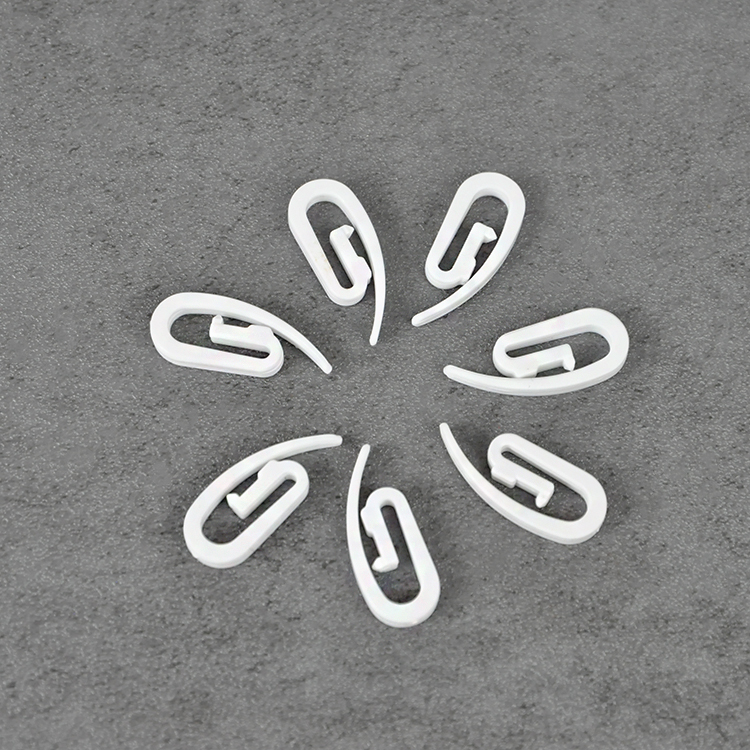
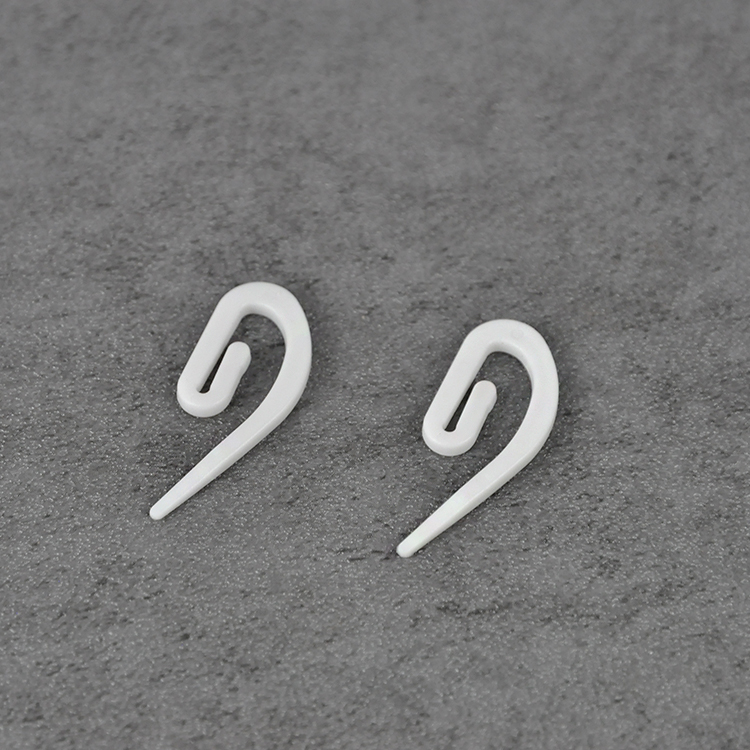
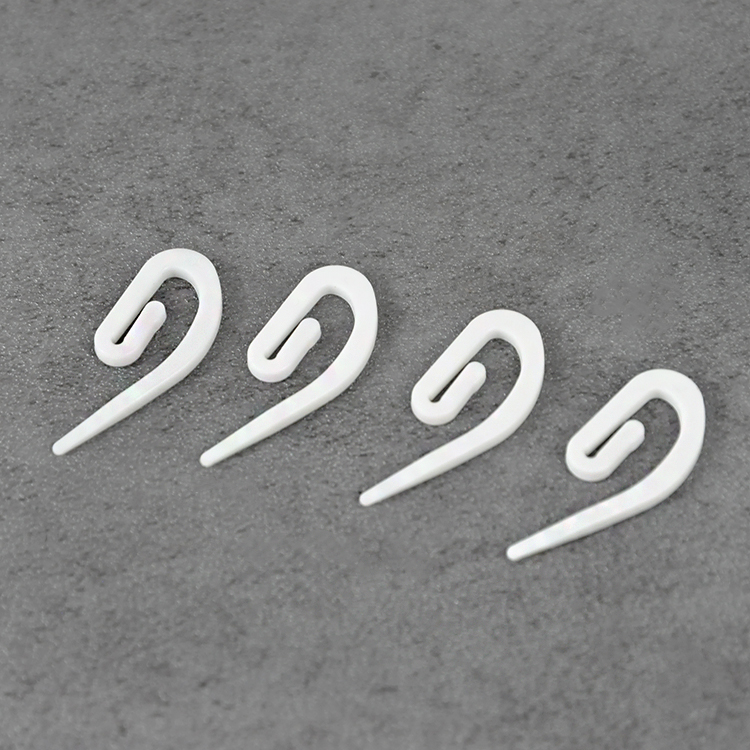

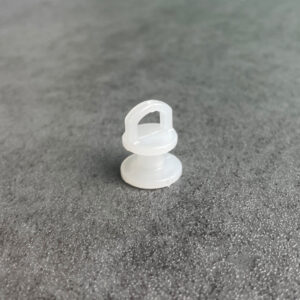
A plastic curtain hook of this type is a single moulded piece formed into a question-mark shape: the loop at the top takes the runner, and the short tail passes through the pocket of the heading. There is no separate pin and no metal to plate, which is what makes it the cheapest hook that still works properly.
R&C supplies it in white, in bulk. These plastic curtain hooks go into net, voile and sheer panels — the lightweight headings where a metal pin hook is more part than the job needs.
Why plastic is the right material here, not a compromise
On a net or a voile panel the load on each hook is small. A metal hook brings strength the heading will never call on, and it brings two problems with it: the plating fails at the tip first, and rust at the tip marks a white net from the inside where nothing can reach it to clean. Plastic has no coating to fail.
Weight matters too. Net and voile are light fabrics on fine headings, and a row of metal hooks hanging on a soft tape pulls the heading down between the fixing points. Plastic hooks weigh almost nothing, so the heading stays where it was set.
The third reason is contact. A moulded hook has no sharp edge turned toward the fabric, so it does not catch, snag or leave a grey line where it sits against white mesh.
The short tail, and why it suits net headings
Net and voile headings are usually shallower than a furnishing tape, and the fabric around them is open mesh rather than a tight weave. A long sharp prong on that material opens a hole and the hole grows. The short tail on these hooks passes through the pocket line and stops, which is why the same hook appears on net curtain after net curtain in the trade.
That also sets the limit for plastic curtain hooks: they need a heading with a pocket to pass through. Where the heading is a sewn pleat with no pocket, or a tape with a deep channel, a pin hook does the job better — see the metal curtain pin hooks for that case.
Net curtain work is a volume business
Net curtains are sold by the metre to a market that expects to replace them. The hook is the cheapest component on the window and the one that gets lost, dropped or thrown away with the old panel — which is why the buyers for this product order in thousands rather than dozens, and why the count per box matters more than any other specification. That is the market white plastic curtain hooks are made for — high count, low unit value, repeat order.
It is also why the white has to match. A net panel is white, slightly warm or slightly cool depending on the yarn, and a hook that reads as a different white shows through the mesh. Consistency between orders is worth more here than a marginally lower price.
Where plastic curtain hooks stop working
Under a heavy lined drape, a moulded hook creeps. The load is sustained, the polymer relaxes slowly, and the heading that was level at handover is not level a season later. Nothing has broken — the part has simply moved — and no amount of adjustment fixes a hook that keeps moving.
So the split is by weight and by fabric, not by price. Sheers, voiles, nets and unlined curtains: plastic. Lined drapes, heavy interlined work, long spans: metal. A supplier who says this plainly keeps the customer; one who sells plastic into a lined-drape job gets the return.
Fitting them into a heading
The count of plastic curtain hooks follows the gather, not the window. A net heading gathered tightly takes more hooks than the same width gathered loosely, and the spacing is set so that no section of heading is left unsupported between two hooks.
On a rod-pocket net heading, the hooks go through the pocket at even intervals and the pocket then holds them in line — which is the reason this hook works on nets at all. Set the first and last hook slightly in from the ends, run the rest evenly between, and the panel hangs without the corners dipping.
Two mistakes account for most of the returns on this part. Hooks pushed through the mesh instead of through the pocket, which leaves a visible hole in a sheer panel. And an uneven spacing that shows as a scalloped top edge as soon as the light comes through.
White, and keeping it white
White is the only finish, and for net curtains it is the only one that makes sense: the hook is meant to disappear against the mesh, not to be seen. It also has to stay that colour, because a net panel sits behind glass for most of its life and any shift in tone shows up against the light.
Moulded white parts do change over years under strong daylight, and a south-facing window with the panel drawn back all day is the worst case. If a project is heading into that position, it is worth flagging at the order stage rather than finding out after the first summer.
Packing and supply
Plastic curtain hooks are supplied loose in bulk, counted by weight, with bagging to the count the order asks for. For a net curtain workroom that means a box sized to a week’s work; for a distributor, a box that splits down into counter packs without repacking the whole consignment.
If the hooks go into a printed retail bag, say so when ordering — the bag count and the header are set before the goods leave, and repacking after the fact costs more than the parts.
Questions buyers ask
Are these the same as metal pin hooks?
Same job, different part. A metal pin hook has a long sharp prong and carries a lined curtain; these have a short tail, no plating and almost no weight, and they are for net, voile and sheer headings. Choosing between them is a question of fabric weight, not of budget.
Will they hold a heavy curtain?
No, and it is better to say so. A sustained load makes plastic curtain hooks creep, and the heading drifts out of level over a season. For lined or interlined drapes the metal pin hook is the correct component.
Do they fit a net curtain rod pocket?
Yes — the pocket is exactly what the tail passes through, and the pocket then holds the hooks in line along the heading. They are not for a sewn pleat with no pocket, where there is nothing for the tail to sit in.
Are they adjustable, like the plastic lift hooks?
No. These are fixed at the point where the tail passes through the pocket, which is why they do not drift. Where the drop has to be corrected after the curtain is made up, the adjustable curtain hooks do that job instead.
Do they come in other colours?
White only at present, which covers net and voile work. If a project needs a colour to match a coloured sheer, that is a conversation worth having before the order rather than after.
Related products
These plastic curtain hooks are filed under curtain rod and track accessories. For heavier curtains the metal curtain pin hooks take the load, and where the drop has to be set on site the adjustable curtain hooks are the alternative. The runners they hang from are in the curtain runners category, and a rail to carry them is in the curtain tracks and rails range — the sliding curtain track for sheers, or the corded curtain track where the rail is out of reach.







 Esperanto
 English
 Arabic
 Russian
 French
Recenzoj
Ankoraŭ ne estas recenzo.