

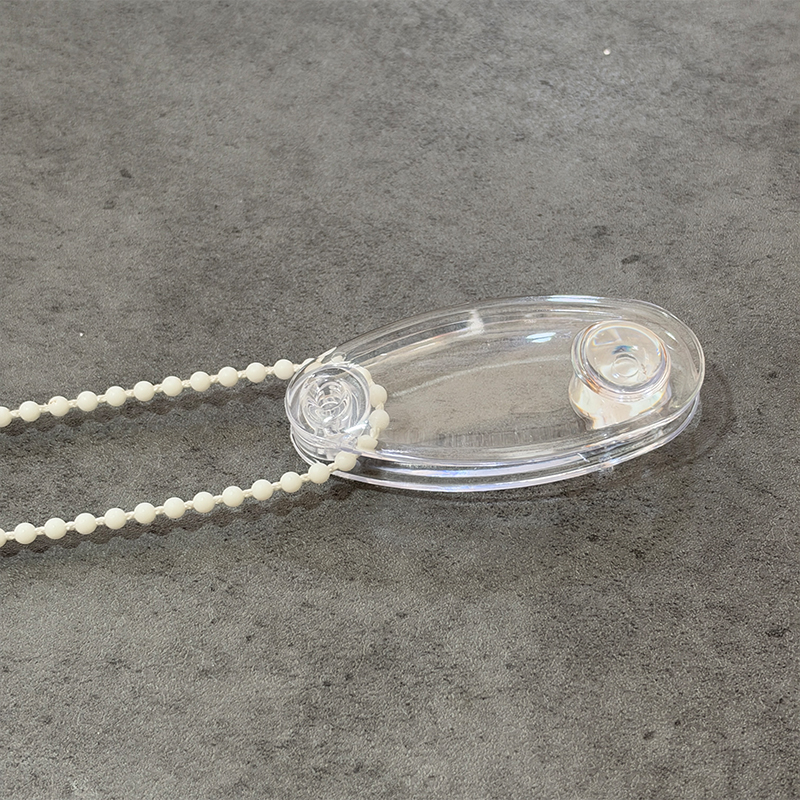
A blind chain holder is the small fitting that pins the control chain loop against the frame so the two strands run side by side instead of swinging free. On a roller blind it sits at the side of the window; on a vertical blind it sits at the bottom of the chain run.
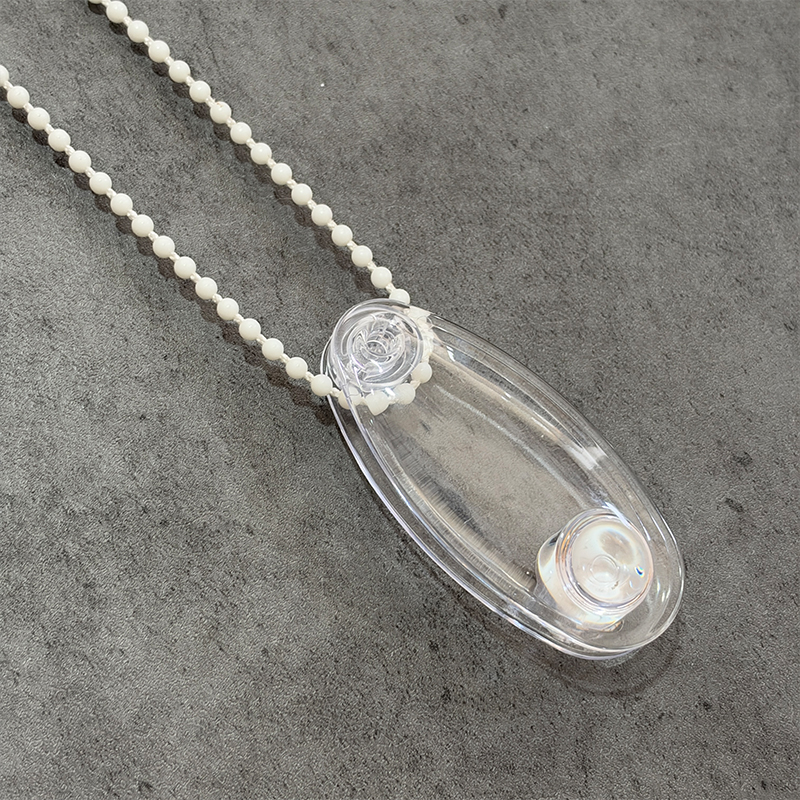
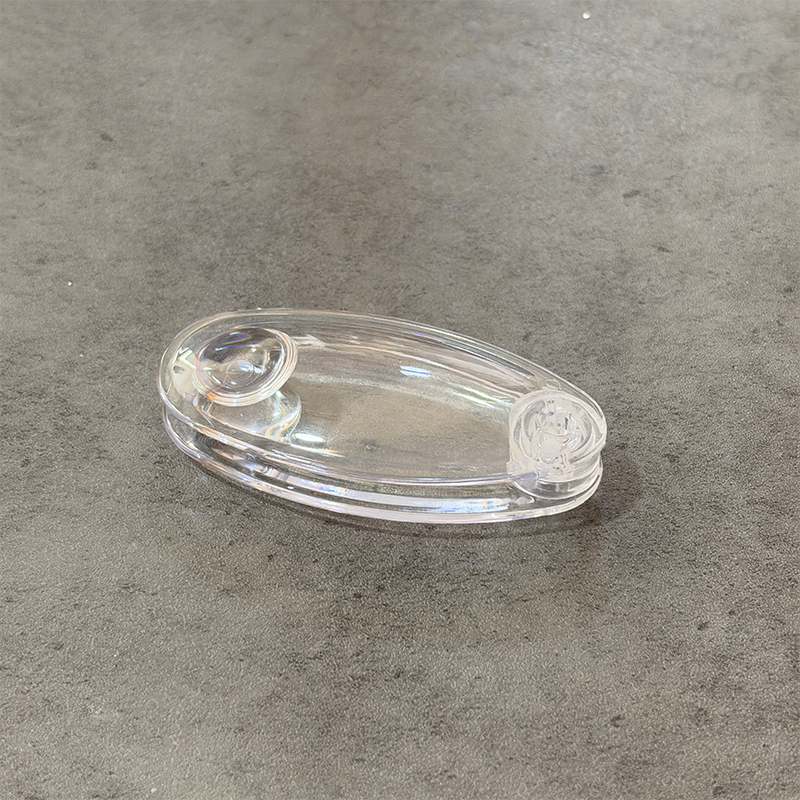
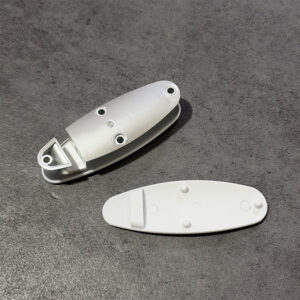
This blind chain holder is clear. The body is moulded in a transparent plastic, so a fitting that would otherwise be a white or grey lump on the frame reads as a reflection instead. That is the whole reason it exists in this material.
R&C supplies it as a spare by the piece and in bulk for fit-outs, alongside the roller blinds and vertical blinds it is fitted to.
What a holder does that a free loop cannot
A control chain hangs as a loop, and a loop with nothing holding it has no shape of its own. It swings when the blind is operated, it twists, and the two strands creep together until they are running as one thick line at an angle across the sprocket.
That angle is what wears a blind out. The chain climbs the teeth, and once it has climbed it either jams the blind at the wrong height or drops off the sprocket — usually at the end of a job, usually up a ladder.
A blind chain holder removes the variable. It pins both strands at one point against the frame, so the loop hangs as two parallel lines with a fixed spacing. The chain leaves the sprocket straight and returns straight, which is the only way it was designed to run.
Why clear, and when it matters
Colour matching is the usual answer to visible hardware, and it works — until the frame is white PVC, the reveal is tiled, or the window is a full-height sheet of glass with the chain hanging beside it. A white fitting on a white frame still casts a shadow. A grey one on a tiled reveal still reads as a grey dot.
A clear body takes on whatever is behind it. On a white frame it looks white, on a dark reveal it looks dark, and against glass it nearly disappears. One clear SKU covers every frame in the range instead of five colours that each only work on one.
For a fit-out that is the practical argument: one part number in the spares list, one box on the van, and no site visit wasted because the colour was wrong. For a single window it is the quieter one — the chain stays where it should and nothing new appears on the frame.
How the loop sits in it
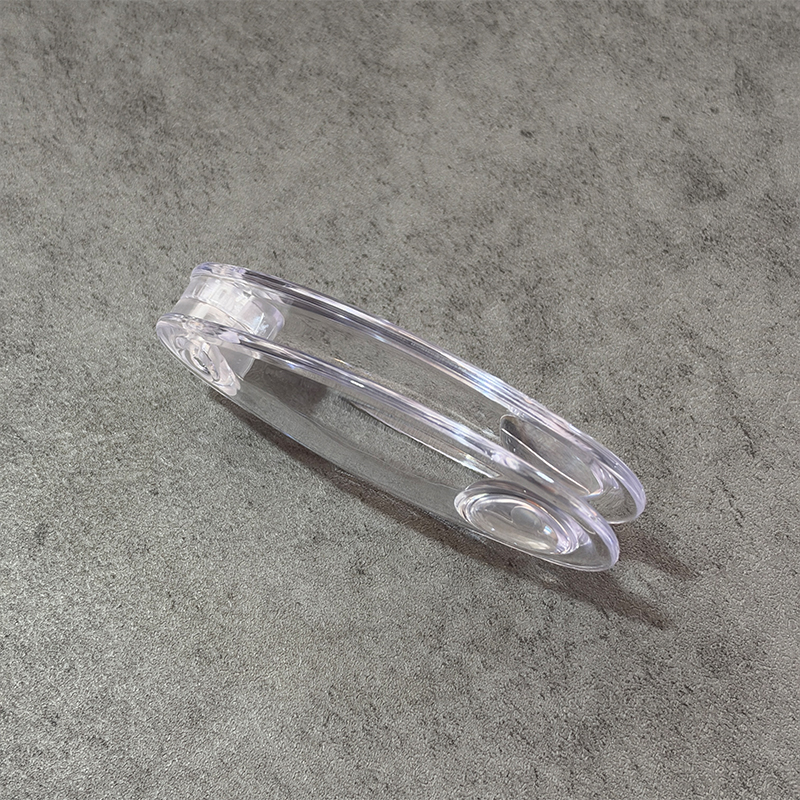
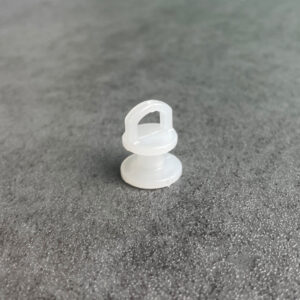
Both strands of the loop pass through the slot at one end of the body and lie in it side by side. The body then lies flat against the mounting face, and the round boss at the opposite end takes the fixing, with the clear cover over it so no screw head shows on the front.
Because both strands sit in the same slot, the holder also sets the spacing between them. That is the part that matters most in service: a loop held at a fixed spacing cannot cross over itself, and a loop that cannot cross cannot climb the sprocket.
It also means the holder can be positioned along the run. Set it high and the loop is held close under the sprocket; set it low and the loop is held near the sill. On a window where the chain hangs beside a curtain, low is usually the better position — it keeps the chain out of the fabric.
Where it goes
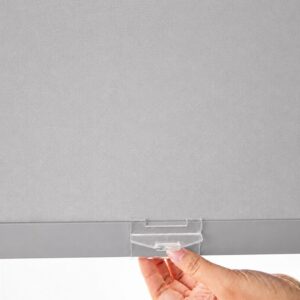
On a roller blind the blind chain holder sits at the side of the window, on the frame or the reveal, at the height where the chain hangs clear of the sill. The chain runs down from the sprocket, through the holder, and back up.
On a vertical blind it usually sits at the bottom of the chain run, near the floor, which also stops the loop tapping against the louvres in a draught. On a roman or a zebra blind it goes wherever the loop hangs closest to a solid surface.
The one rule is that the body has to sit flat. A blind chain holder mounted across a rebate, a bead or a corner bead sits proud, the strands lift out of the slot, and the whole point of the part is lost. If there is no flat face where the chain hangs, the fix is to move the holder, not to force it.
Which blinds it suits
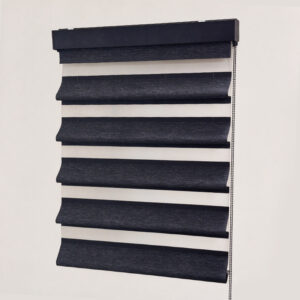
Any blind controlled by a bead chain loop: roller blinds including the day and night types, zebra blinds, vertical blinds, roman blinds with a chain loop, and the corded tracks in the same range.
It does not suit a blind with no loop. A spring-loaded cordless roller such as the no drill roller blinds has no chain to hold, a motorised blind is driven at the headrail, and a wand-tilted vertical blind has a wand where the chain would be. There is nothing for a holder to hold on any of those.
Holder, weight or tensioner
Three parts sit on the same chain and they are not interchangeable, which matters when a building is being ordered for rather than one window.
A blind chain holder pins the loop to the frame and does nothing else. It has no mass and no spring, and its job is geometry: keep the two strands parallel and keep the loop off the glass.
A weight hangs on the loop and adds mass, holding the chain down and the loop vertical without anchoring it. That is the blind chain weight.
A tensioner is fixed to the frame under spring pressure and keeps the lower run short, which is the part that matters where a loop hangs low enough for a child to reach. That is the blind chain tensioner.
A common arrangement on a fit-out is a holder at every window and a tensioner wherever the loop hangs low. The holder tidies the chain; the tensioner is the safety part.
What to check before ordering
The loop. A bead chain and a cord loop do not sit in a slot the same way — a chain seats between the beads, a cord seats on the cord itself. A photo of the loop next to a rule settles it faster than any description.
The surface it lands on. PVC frame, timber, plaster, tile and glass all take a different fixing, and the holder is only as good as what it is attached to. A photo of the frame where the chain hangs is the one thing worth sending before a box ships.
The join in the loop. Every loop is joined somewhere. If the connector sits where the holder needs to go, the holder has to move a little up or down the run — worth knowing before the position is marked on site.
What these are not
Not a chain connector: a connector joins two chain ends into a loop, a holder clips onto a loop that is already joined. Not a weight, and not a sprung tensioner, for the reasons above. And not a cure for a worn sprocket — if the chain is climbing because the teeth are hooked, a blind chain holder will hold the loop straight and the chain will still climb, and the sprocket is the part that needs changing.
For the brackets, runners and track parts that go with the same range, see curtain rod and track accessories. For volume pricing, samples and the colour question on clear parts, send the frame photo through the inquiry form.







 Esperanto
 English
 Arabic
 Russian
 French
Recenzoj
Ankoraŭ ne estas recenzo.