


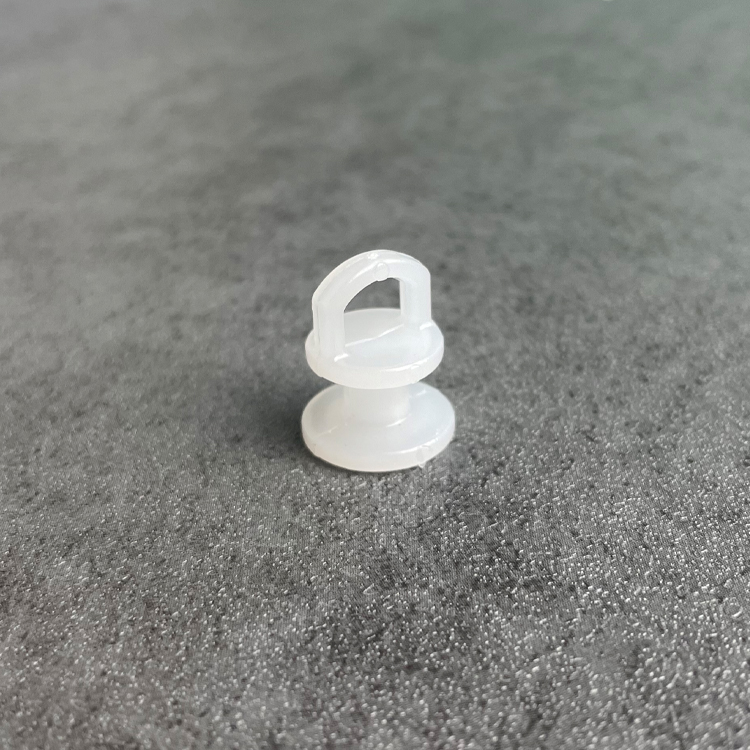
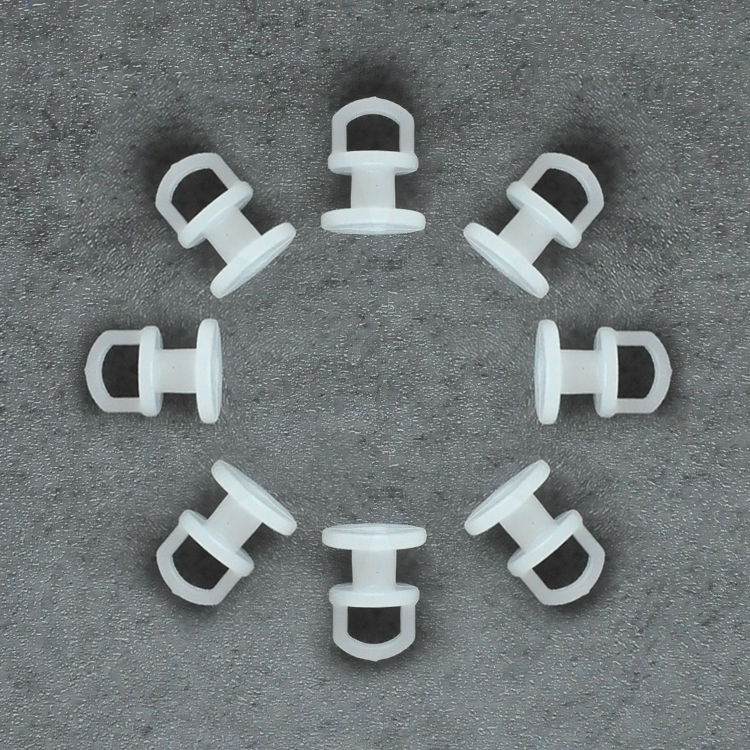
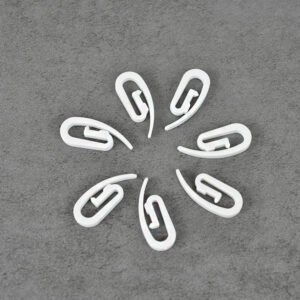
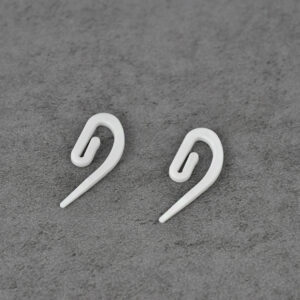
A curtain track glider is the part that runs in the track and gives the curtain hook something to hook into. This one is white plastic with a moulded eye on the body: the hook passes through the eye, so the glider and the hook stay two separate parts.
That split is the point. The curtain track gliders stay in the track, the hooks stay in the heading tape, and either can be replaced without touching the other. Re-make a heading and the hooks change; restring a track and the gliders change. Nothing has to be cut off and nothing has to be re-sewn.
R&C supplies them white as standard, as spares by the piece and in bulk for fit-outs, alongside the tracks and the hooks they work with.
What the eye is for
On a curtain track glider the eye is the interface between the track and the curtain, and its job is to let the hook hang freely rather than fix it. A hook passed through an eye can swing as the curtain is pulled, which is what stops the heading from twisting when one edge is drawn further than the other.
Because the eye is moulded into the body rather than added to it, there is nothing to work loose. A metal ring can be bent open by a heavy heading and let the curtain drop; a moulded eye either holds or it wears through, and it wears through slowly.
It also means the hook is your choice, not ours. Standard pin hooks, adjustable hooks and plastic hooks all pass through the same eye, so one glider covers a heading that has to be set at a different drop in a different room.
How a glider sits in the track
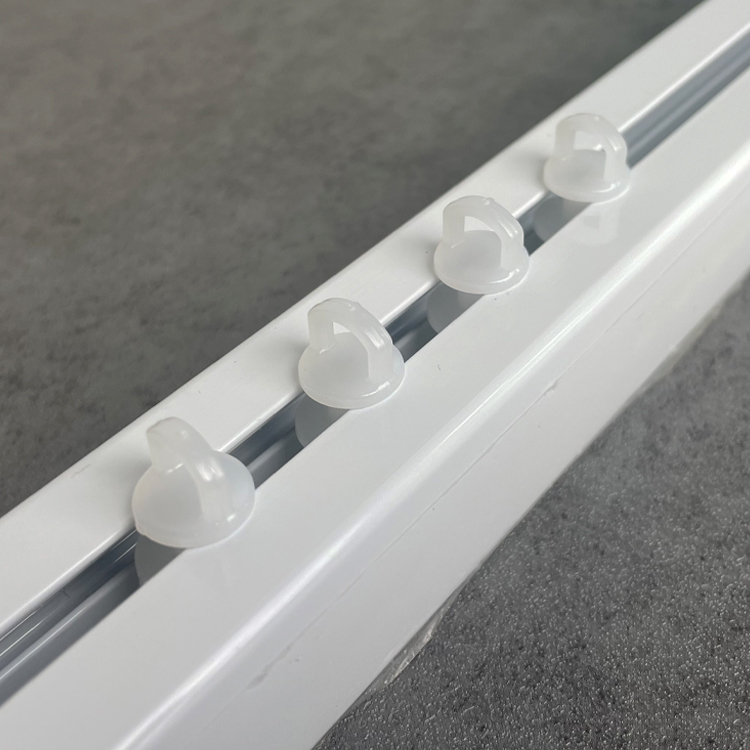
The body of this curtain track glider is a stem with a flange at each end. The upper flange runs inside the channel, the neck passes through the slot, and the lower flange sits under the track, so the glider is held on both faces of the opening and cannot lift out or drop through while the track is closed.
That is what keeps the eye hanging square. A glider that can tilt in the slot hangs its hook at an angle, and on a long run the tilt accumulates until the curtain reads as crooked. Held on both faces, the eye stays vertical and every hook in the run hangs the same way.
Loading follows the profile: on most runs the end cap comes off and the gliders slide in from the end; on profiles with a widened entry the glider presses up through the slot and turns to seat. Both are done with the track empty — forcing a glider past a fitted end cap is how a flange gets chipped.
Glider or roller
The other option in the same range puts a small wheel in the channel instead of a sliding body, and the choice between them is about how often the curtain moves rather than which is better made.
A curtain track glider slides, so the whole body takes the travel and the wear is spread along the neck. A roller turns, so the wear sits in one small wheel that rotates. On a window opened once a day, a glider will outlast the curtain; on a run pulled every morning in a hotel, a wheel is the part that keeps the pull light for longer.
Both take a hook through an eye or on a hook, both fit the same slot profiles, and mixing them on one track is fine as long as the necks match the slot. For the wheel version see the curtain track rollers page.
Which tracks these fit
Curtain track gliders need a slot with a channel behind it. Three things have to line up: the neck has to pass through the slot without rubbing, the flanges have to sit flat on both faces of the profile, and the eye has to clear the track edge so the hook swings without catching.
They suit the slot-profile tracks in the range — the PVC single, double and triple profiles, the corded and the motorised tracks, and the aluminium profiles where the slot matches — and the cubicle and privacy runs built on the same pattern.
They do not suit a track with a C-channel and no slot, or one whose slot is narrow enough that the neck binds. A photo of the profile cross-section with a rule against the slot answers it in one look, and that is the question behind most returns on parts this size. The name varies between trades — curtain gliders, curtain rail gliders and track gliders are all this part — and the profile drawing settles which size you need.
What these are not
Curtain track gliders are not ring carriers. A ring carrier has a metal ring hanging from the body, for a curtain that already has rings or eyelets sewn in. This has a fixed eye, for a curtain that uses hooks. Both fit the same tracks, and the heading decides which you need.
They are not S-fold or wave carriers. Wave headings hang from carriers that clip into a wave tape at a fixed pitch. Those hold the fold; this holds a hook.
They are not hooks. The glider is the part that travels; the hook is the part that grips the heading. Ordering one does not get you the other, and a fit-out usually needs both lines on the same purchase order.
Counting gliders for a run
One glider carries one hook, so the count for a set of curtain track gliders comes from the heading. Count the pockets in the pleat tape, or the hook positions on the heading, and that is the number of gliders.
Two adjustments are worth making. Add spares — they are small, they get lost between the sofa and the wall, and a bag of ten costs less than a second delivery. And on a track that has been in service for years, count what comes out rather than what goes back: a run that has lost gliders is usually short of a full set, and the curtain has been hanging with uneven gaps ever since.
If the heading is being made rather than replaced, the spacing is the curtain maker’s decision. Once the hook positions are set, the glider count follows from them.
Where they go
Replacing a worn set. The commonest order. A track that is sound but drags usually needs new curtain track gliders, not a new track.
New heading on an old track. A heading re-made with a different pleat spacing needs a glider for every new hook position, and the old gliders are rarely the right count afterwards.
Hotel and serviced apartment turnover. Curtains come down for cleaning on a cycle, and gliders take the handling. Stock on site means the room goes back the same day.
Hardware packs. Fitters who supply the track and the heading together put gliders and hooks in the same box, because a job that arrives short of either is a second visit.
Care
Leave the slot dry. Oil in a track collects dust until curtain track gliders stop sliding and start dragging, and a dragging glider wears a flat on the neck. A dry cloth along the slot once a year does more than any lubricant.
Check the eye for wear, not just the body. The eye is where the hook rubs, and a hook that has been forced through a worn eye will drop out under the weight of a lined curtain. If the eye has opened out, replace the glider — closing it with pliers work-hardens the plastic and it will crack.
Questions buyers ask
Will these fit my track?
If the track has a slot with a channel behind it and the gliders already in it look like this — a plastic body with an eye or a ring below — they will. Curtain track gliders are matched on the slot rather than on the brand of the track, so if the slot is a different width, send a photo of the profile cross-section with a rule against it and we will confirm before you order.
Do I need to buy hooks separately?
Yes. The glider gives the hook an eye to pass through; it does not include the hook. Pin hooks, adjustable hooks and plastic hooks all fit the same eye, so the hook is chosen by the heading, not by the track.
Ring carrier or glider — which do I need?
It depends on the curtain. A heading tape with pockets takes a hook and therefore a glider. A curtain with rings sewn in or eyelets punched through takes a ring carrier. The track does not decide it; the heading does.
How many curtain track gliders do I need?
One per hook position in the heading. Count the heading rather than measuring the track, add a few spares, and on an old run count what came out of the track rather than what goes back in.
Do these work on a corded track?
In the run, yes. The two end positions are master carriers that the cord attaches to, and those are a different part — keep the masters that came with the track and order ordinary gliders for the span between them.
Related products
These curtain track gliders sit in the curtain runner range with the wheel version and the ring carrier for ring-top headings. The hooks that pass through the eye are the metal curtain pin hooks, the plastic curtain hooks and the adjustable curtain hooks. The tracks they run in are the PVC single curtain track, the double curtain track, the corded curtain track and the aluminium adjustable curtain track. Bulk or OEM quantities go through the enquiry form.








 Arabic
 English
 Russian
 French
 Esperanto
المراجعات
لا توجد مراجعات بعد.