


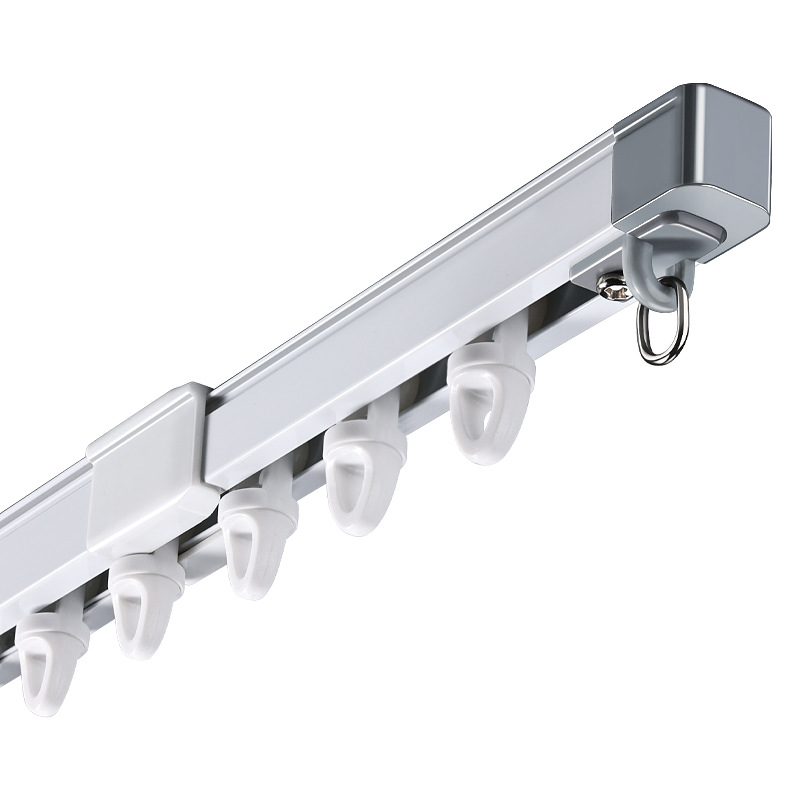
A curtain track normally arrives at a fixed length and gets cut on site. This one slides. Two aluminium sections run one inside the other, you pull them apart until the track spans the wall, and the overlap in the middle takes up whatever length is left over. Nothing is cut, nothing is thrown away, and the track can be shortened again for the next window.
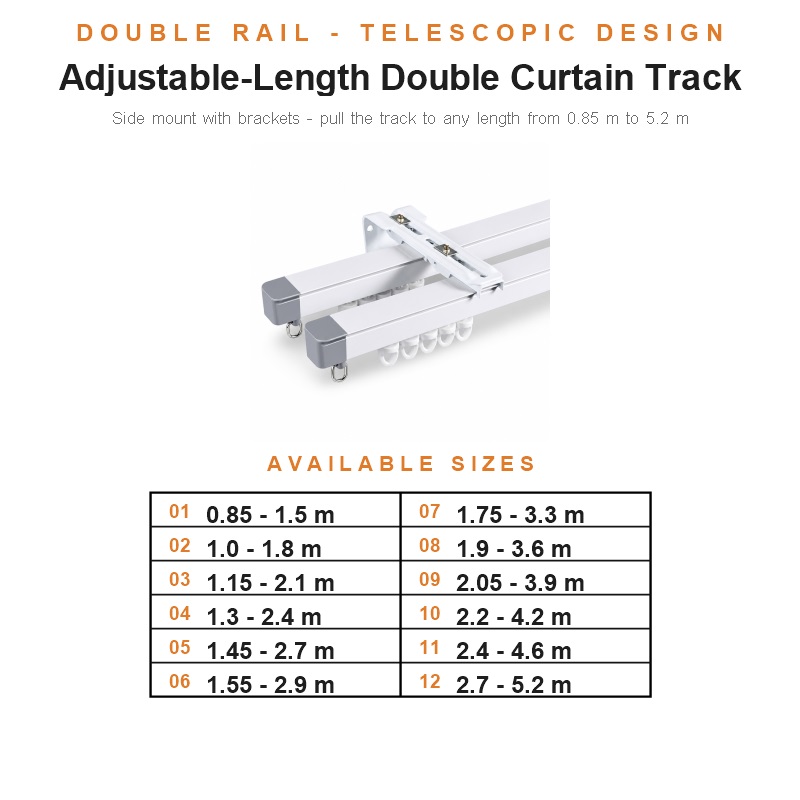
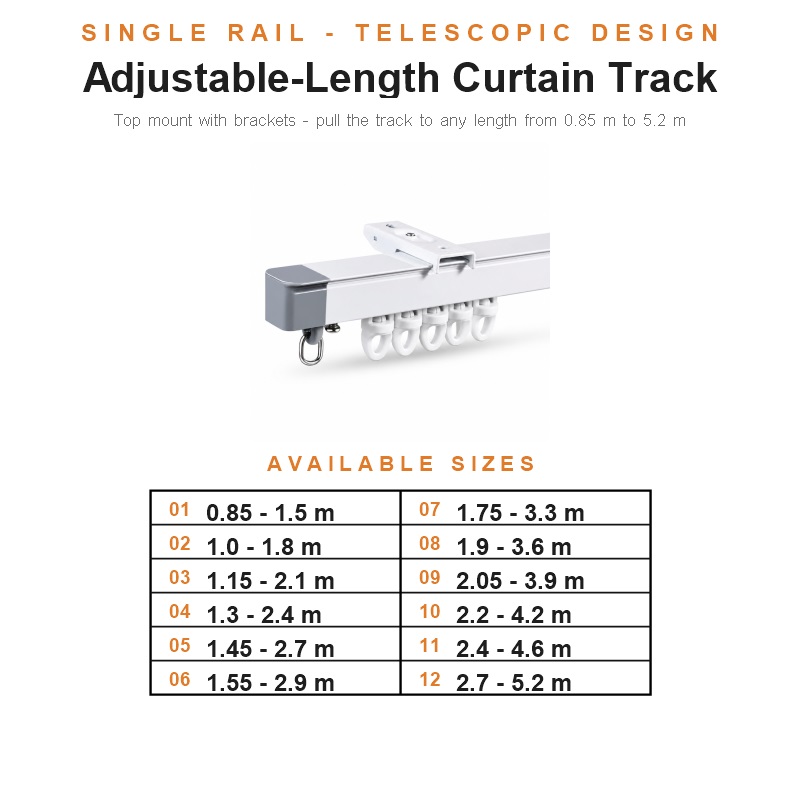
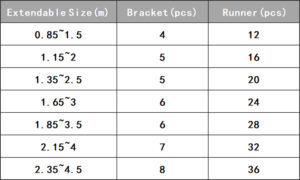
The adjustable curtain track is supplied in twelve stocked ranges that between them cover 0.85 m to 5.2 m, in a single-rail version for a ceiling fixing and a double-rail version for a wall fixing. Both versions work the same way.
R&C supplies it to distributors and fitters as well as to individual buyers, with the brackets, runners and end caps that go with the length.
What “adjustable” means on this track, and what it does not
It is not a track that bends, and it is not a telescopic pole. It is two straight aluminium sections with one sliding inside the other, and the overlap between them is the mechanism: the further you pull, the shorter the overlap.
That has one consequence worth understanding before the order. The overlap is what gives the track its stiffness, so a track pulled almost all the way out has the least of it, right where a long run needs it most. That is the reason the range is split into twelve bands rather than one track that does everything: each band puts your length somewhere near the middle of its travel, so a 3.4 m window uses the 1.75–3.3 m track pulled out a little, not the 1.3–2.4 m track pulled past its limit.
Pick the band that leaves your measurement inside it with room to spare at both ends. A track that only just reaches is a track running at the end of its travel.
Why an adjustable curtain track beats one you cut
Nothing lands on the floor. Cutting an aluminium track means a hacksaw, a file, and a fine grey dust that gets into carpet and does not come out. On a furnished room that is the argument on its own.
Nothing is wasted. A cut track leaves an offcut nobody can use. A distributor stocking these covers every length in a band with one reference, and a fitter carrying a short range covers a whole day of windows without knowing the sizes in advance.
It can go back. A track that has not been cut can be returned, exchanged for another band, or taken to the next address. A cut one cannot.
The ends stay finished. The end caps arrive fitted and stay fitted, because the length is set at the overlap rather than at the end of the profile.
Single rail or double rail
Single, top mount. One channel, brackets that fix upward into a ceiling or a soffit. The track hangs under the fixing, which is where a curtain wants to be when the window has no wall above it or when the curtain is meant to run past the window onto the wall.
Double, side mount. Two parallel channels on brackets that fix to the wall above the window. The point of a double rail is two layers: a sheer running in the channel nearest the glass and a drape in the one in front, each opening on its own. It is what you specify when the window needs privacy by day and a heavier curtain at night, without two separate tracks fighting for the same wall.
Which one is possible is decided by the building, not by preference. A ceiling that is not there, or a soffit that stops short of the window, rules out the top mount before anything else matters — so decide the mount first, then the length.
Aluminium, and why the long ones have to be
An adjustable curtain track has one job beyond holding the curtain: it has to be straight. Runners do not slide evenly on a track that bows, and on a long run a bow shows up as a curtain that bunches at the middle and hangs open at the ends.
Aluminium holds its line over a span in a way that a plastic profile does not, and that is why the long bands in this range are aluminium extrusions rather than PVC. The short ones could be either — PVC is cheaper and quieter in use — but a single material across the range is simpler to specify and means the 4.6 m track behaves like the 1.5 m one.
The finish is white, which is the finish that disappears against a ceiling and matches white brackets without a second decision.
The overlap, and what to know before hanging something heavy
Runners have to cross the joint, so the overlap is a sleeve the runners pass through rather than a fixed connector. That works, provided the track is set up with the joint in mind.
Bracket the joint. The middle of a long track is where a heavy curtain pulls hardest, and on an adjustable curtain track that is also where the overlap sits. A bracket close to the joint takes that load into the fixing instead of into the sleeve.
Do not run a heavy drape at full extension. If the measurement sits at the very top of a band, the overlap is at its shortest and the track at its least stiff. Move up a band and run it shorter — the cost of the next size is small next to a track that sags in the middle of a bay of curtains.
For a normal domestic curtain, none of this is a consideration. It matters on long runs, on heavy interlined drapes, and on contract work where the curtain is heavier than a house curtain.
Fitting, and what to send with an enquiry
Measure the run, not the window. An adjustable curtain track has to span the fixing points, and a track that runs past the window at both ends is what stops light at the edges — so measure where the track will sit, including any overrun.
Decide the mount. Ceiling for the single rail, wall for the double. On a window with a deep reveal the ceiling inside the reveal may be the only usable surface, and that changes the length you need.
Check the shape. This is a straight track. A bay, an angled wall or a curve needs a track that bends — the flexible aluminium option in the range covers that, and it is a different product rather than a different setting on this one.
Then send the length, the mount, single or double, and what the curtains weigh. With those four answers the band is chosen, the brackets counted and the quote issued without a second round of questions.
Where an adjustable curtain track earns its place
A long run. A wall of glass, a sliding door, an open-plan opening — the lengths that would otherwise need a joint, a splice and a careful cut.
A rented flat. Fixed to the ceiling or the wall with brackets, taken down at the end, and short enough for the next window when it moves.
A shop window or a display. Changed between seasons, re-hung to a different width, and never cut to fit one layout.
A room divider. A long span with a light curtain on it, where the track is doing the work of a wall.
Contract and clinic work. Privacy runs that get installed to a measured opening and occasionally re-set; the flexible track in the range handles the ceiling curves, this one handles the straight spans.
Care
Wipe the profile with a dry cloth. Do not oil the runners: a dry runner on an aluminium track slides freely, and oil attracts dust into the channel until it stops sliding freely at all.
Check the joint once a year on an adjustable curtain track that is regularly pulled open and closed — the sleeve takes the wear, and a joint that has worked loose shows up as a step the runners catch on. Re-seat it and check the fixing near the joint at the same time.
Questions buyers ask
Do I have to cut it to length?
No. An adjustable curtain track pulls out to the length you need and the overlap takes up the difference. Cutting is only ever needed if the measurement falls outside the band, which is why the range is split into twelve.
What is the longest length?
5.2 m, on the largest of the twelve bands. The smallest band covers 0.85 m to 1.5 m, and the bands step up from there.
Will it go round a bay window?
No — this is a straight track, and bending an aluminium extrusion with a sliding joint in it is not something to attempt on site. A bay needs a flexible track, which is a different product in the same range.
Single or double?
Single if the curtain is one layer and there is a ceiling to fix to. Double if you want a sheer and a drape on separate channels, which is a wall fixing. The mount decides the version more often than the curtain does.
Will it hold a heavy curtain?
It will, within the limits of the band you choose — and the limit is the overlap, not the profile. Keep the measurement inside the band rather than at the top of it, bracket close to the joint, and say the curtain weight at the enquiry so the band can be chosen around it.
Related products
This adjustable curtain track sits in the curtain tracks and rails range with the extendable motorized curtain track for the same long spans driven by a motor, the corded curtain track with a pull cord, and the PVC double curtain track for a lighter twin-rail job. For a bay or a curve, the flexible aluminium curtain track bends where this one cannot, and for a track that disappears into the ceiling there is the recessed curtain track. Brackets are also supplied on their own as curtain track brackets, and wholesale or OEM quantities go through the enquiry form.







 Esperanto
 English
 Arabic
 Russian
 French
Recenzoj
Ankoraŭ ne estas recenzo.