


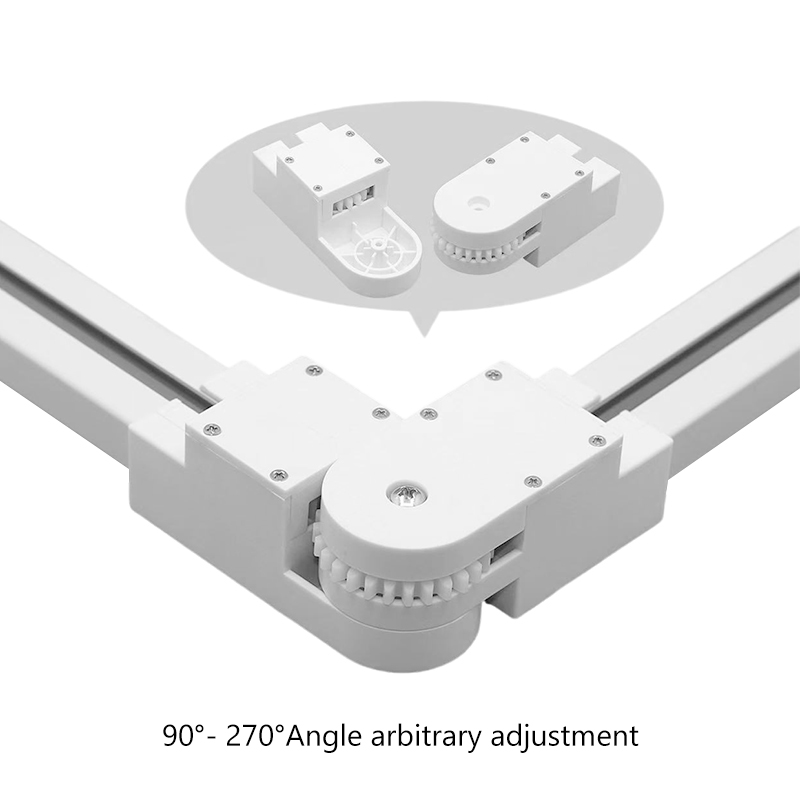
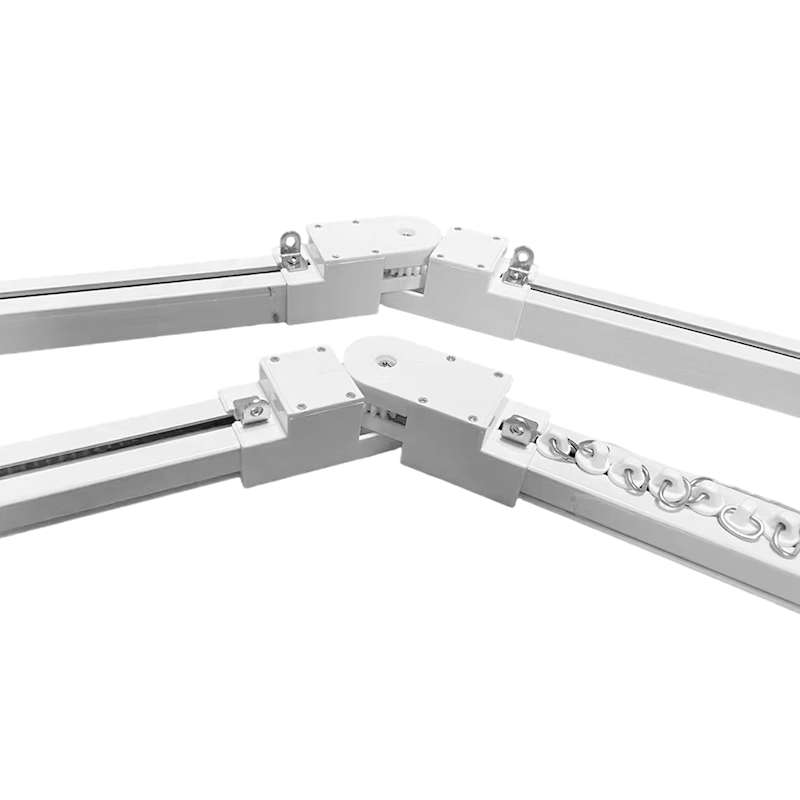
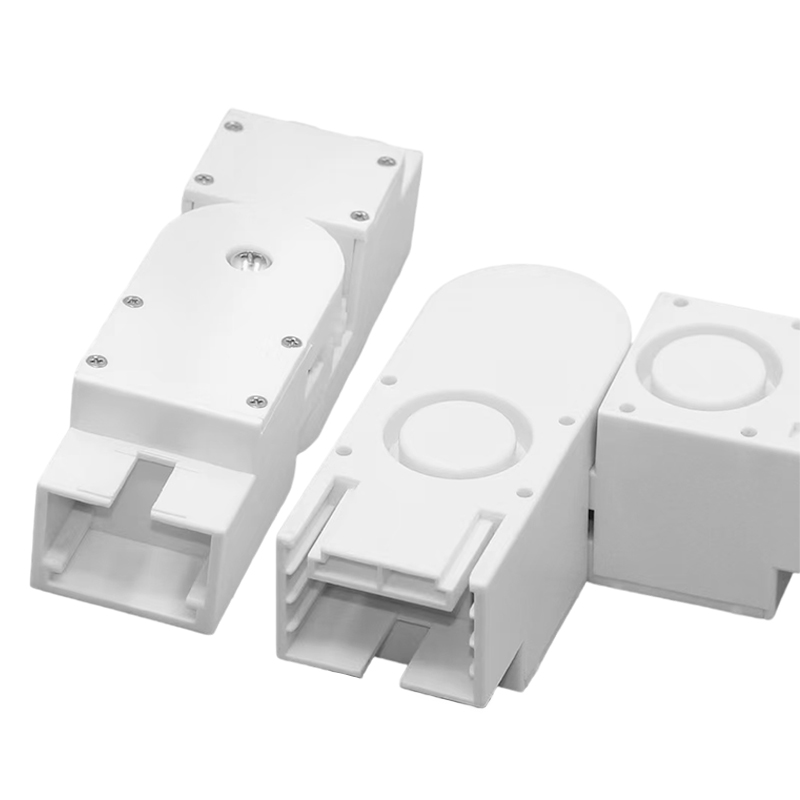
A curtain track corner connector joins two lengths of straight motorized rail at an angle. It closes the end of one extrusion, takes the end of the next, and turns the belt around a guided pulley inside the housing so the drive keeps working through the bend.
This is the part that lets a straight track follow a room instead of stopping at the first corner. Without it, a bay, an L-shaped run or a return into a wall has to be built from a curved track — and a curved track cannot be motorised the same way, cannot be cut on site, and cannot be shipped flat.
What it solves — a straight rail that has to turn
Motorized tracks are extruded straight. That is not a limitation anyone chose, it is what makes them cheap, rigid and shippable. But rooms are not all straight, and a window that wraps a corner needs the track to follow it.
A curtain track corner connector is how that is done without giving up the straight extrusion. Two straight runs, one connector, and the belt path is continuous through both. The alternative — a purpose-made curved track — costs more, takes weeks, and cannot be adjusted once it arrives.
It is worth being clear about what this is not. A flexible track that bends by hand along its whole length is a different product, and it is the right answer for healthcare and privacy screening where the rail has to follow a free curve. This connector is for a hard corner at a defined angle, built from standard rail.
The adjustable angle
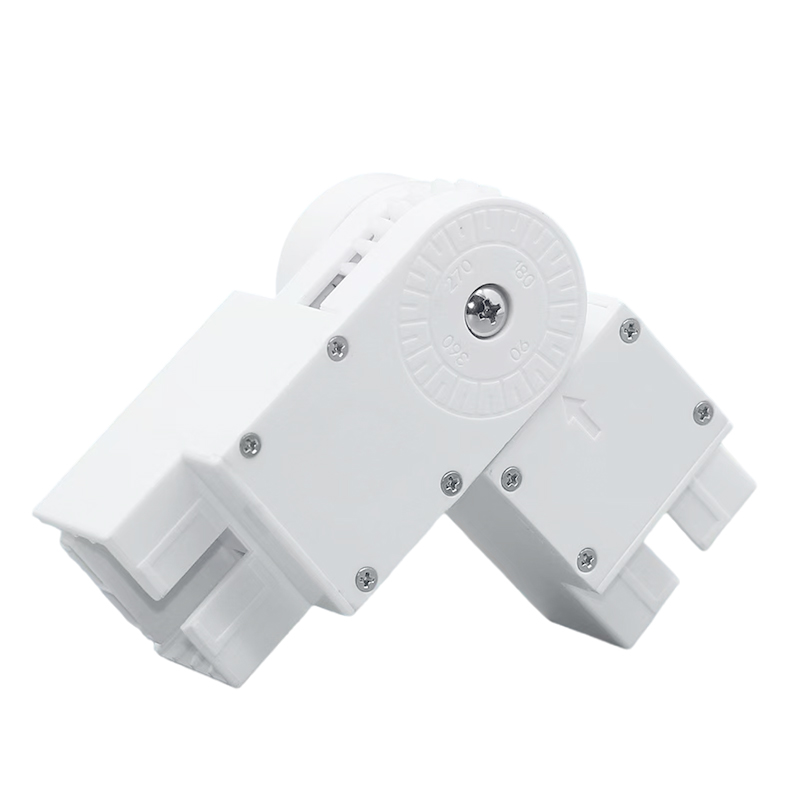
The two halves of a curtain track corner connector rotate against each other on a marked scale, and a central screw locks the setting. That means one part covers every angle a room is likely to present, rather than a separate fixed connector for each — which matters when a job has three windows at three different angles and the order is placed from a drawing.
Set the angle before the rail is cut, not after. The connector changes the geometry of the run, and a rail cut to the wall-to-wall measurement will be long or short once the angle is applied. Work the angle out from the plan, set the connector, then measure the two straight runs from it.
The lock screw is the part to check on a callback. An angle that has moved a few degrees after a year of operation is almost always a connector that was set but not tightened, or tightened against a housing that was not seated on both rails first.
The belt has to run through the bend
This is the reason a curtain track corner connector is a mechanical part rather than a shaped piece of plastic. The belt arrives along one rail, has to change direction inside the housing, and leave along the other rail — and it has to do that with the teeth still engaged and without the belt rubbing its edge against the housing wall.
The guided pulley inside the housing is what carries the belt around the turn. It has to be the right size for the belt, and the belt has to sit in its groove rather than beside it. A belt that runs beside the pulley will work for a while and then start skipping at the corner, which is a symptom that is easy to misdiagnose as a stretched belt.
Tension is set at the drive end, not here, but the corner is where a badly tensioned belt shows up first. If a run with one corner keeps losing position at the same point, the connector is the place to look before the motor.
Matching it to the track and the belt
Three things have to line up, and only one of them is visible on a photo.
The track profile. The connector closes the extrusion, so the top width, the height and the slot underneath all have to match. A connector that is close but not exact will fit and then let the belt wander.
The belt. The pulley inside is sized for a particular belt. A belt that is wider or narrower than the groove will not track round the corner properly, however well the connector is fitted.
The motor direction. On a run with one corner the curtain travels out and back through the same bend, so the geometry has to work in both directions. Send the plan with the corner marked rather than the two rail lengths on their own.
This curtain track corner connector is built for the motorized aluminium tracks in the curtain tracks and rails range, and pairs with the curtain track belt and the curtain track drive unit on the same system.
Questions buyers ask
Is this the same as a curtain rail corner connector?
Yes — curtain track corner connector and curtain rail corner connector are the same part under two names, and the split is regional: buyers in Australia and the UK tend to search rail, buyers in the US tend to search track. It fits the same extrusion either way.
Can I use two of these on one run?
Yes, and it is common on a bay where the track steps around two corners. Each connector adds its own belt path, so check that the total run stays within what the motor can drive rather than assuming a second corner is free.
Does it work with a hand-operated track?
The housing will take the rail, but there is no reason to buy it for a manual run — a hand track does not need a belt path through the corner, and a plain corner joint does the same job for less. This part exists to keep a drive belt continuous.
How do I order the right angle?
The angle is set on site, not ordered. What has to be right at order stage is the track profile and the belt, not the degrees — send the profile or the track model.
Related products
This corner connector belongs to the curtain rod and track accessories range. It is used with the curtain track belt and the drive unit, on the extendable motorized curtain track and the electric curtain track with LED light. Where the rail has to follow a free curve instead of a defined corner, the flexible hospital curtain track is the right product.









 Esperanto
 English
 Arabic
 Russian
 French
Recenzoj
Ankoraŭ ne estas recenzo.