


A triple curtain track carries three curtains on one ceiling fixing. Three parallel channels on a single extruded body, each running its own runner, each pulled by hand. R&C supplies it as a PVC triple rail with matching end caps, cut to the lengths your order needs.
Three curtains in one room is a specific requirement, not a common one. Where it comes up — a suite that needs a sheer, a blackout and a decorative face on the same window — doing it with three separate tracks means three fixing lines, three cutting lists and three chances of a projection error. One triple track removes all of that, and it is the only way to keep the three fabrics at a fixed distance from each other.
When a window actually needs three rails
Most buyers asking about a triple curtain track are trying to solve one of three problems. Worth checking which one before the order, because it changes what gets quoted.
Three layers of fabric. A sheer that filters daylight, a blackout that stops it, and a decorative face that is what the room is actually dressed with. Each has a different job and they are almost never opened together — the sheer stays drawn, the blackout goes up at night, the decorative pair stays in place. Three separate behaviours need three channels.
Two curtains plus a fixed face. A blackout and a sheer that both move, with a third channel carrying a face fabric or pelmet that does not. This is the arrangement that lets a hotel room look dressed while the guest controls the light independently.
A theatrical or staged sequence. Where a front, mid and back drop have to travel on the same axis — small stages, presentation rooms, display windows. Here the three channels are working channels rather than decorative ones, and the load per channel matters more than the appearance.
If only two of those three are needed, a double is cheaper and takes a narrower fixing footprint. That is what our PVC double curtain track is for. And if the window only ever carries one curtain, the single rail does the job for less again.
Three channels on one fixing line
A triple curtain track runs its three channels parallel on one moulded body, so the whole assembly hangs from a single set of fixings. That is the point of the product: three curtains, one drill line, one height, one cutting list.
The channels are independent. Runners are pushed along each one separately, which means the blackout can be closed without disturbing the sheer, and the decorative face never has to move at all. Nothing couples the three.
Set the order of the channels before the rail is cut. Which fabric goes on the channel nearest the glass is a decision that cannot be changed on site once the brackets are up, and getting it wrong means the sheer ends up behind the blackout and the room never quite works. On most schemes the sheer takes the front channel, the blackout the middle, and the decorative face the back.
PVC triple track or aluminium triple track
Same rule as everywhere else in this range: it is about duty, not quality.
| PVC triple track | Aluminium triple track | |||
|---|---|---|---|---|
| Curtain weight | Sheers, voiles, standard blackout, light decorative face | Heavy interlined drapes and stage weights | ||
| Span | Domestic and standard room widths | Long runs and wide openings | ||
| Appearance | Plain white, sits tight to the ceiling | Can be finished to match | ||
| Cost per metre | Lower | Higher | ||
| Motorisation | Not applicable, hand operated | Available in the electric range | ||
| Best for | Suites, serviced flats, display windows | Stages, heavy drapes, long spans | ||
Where any of the three curtains is interlined, or the run is longer than a domestic window, the aluminium system is the better specification — see the aluminium double track system as the starting point for a heavier build. Where all three fabrics are standard weight, this PVC triple curtain track does the job at the price.
Runners and end caps across three channels
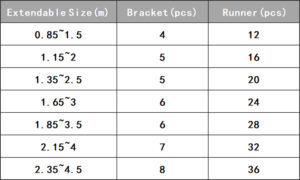
A triple curtain rail takes three channels of runners, so the count is three times a single, not one and a half. Work it out per channel against the fabric each one carries — a sheer on a wide channel needs more runners than a decorative face that rarely moves.
Runners and end caps are quoted as separate lines so the quantities follow the window schedule rather than being estimated for the rail as a whole. A short runner cannot be improvised on site, and on a triple the shortfall shows up on the channel nobody counted.
End caps on this rail close all three channels at each end in one piece. That is why they have to be ordered with the track — a triple cap is not three single caps, and it is not something a fitter can make up from stock.
Fixing to the ceiling
Three channels make a wider body than a double, and the fixing has to land on a solid line rather than on the edge of a plasterboard sheet. The section fixes flat against the ceiling on its top face, so there is no bracket arm to align — but there is more load sitting further out from each fixing point, which is why the fixing count matters more here than on a single.
Before cutting, establish the ceiling type: concrete soffit, plasterboard on battens, metal deck or suspended grid. Each takes a different anchor. On a suspended ceiling the track needs to be fixed back to the grid or to a pattress, not to the tile.
Send the ceiling type and the span and the fixing positions come back marked on the cutting list.
Cutting, packing and order quantities
The triple curtain track is cut to length before packing — all three channels cut together and the caps matched to the same cut. For projects the usual pattern is one carton per window, labelled by room.
Three channels make a bulkier rail than a double, so carton counts per container are lower than buyers expect if they are quoting from single-rail experience. Worth checking the loading plan before the order is confirmed rather than at the port.
Order as cut lengths against a window schedule, as full lengths for a distributor who cuts locally, or as mixed cartons where several window sizes ship together.
What to send for a quotation
- A window schedule — width and drop per opening, or the number of openings and the typical size
- Which fabric goes on which channel, front to back
- The ceiling type
- Whether the track ships as cut lengths or full lengths
With those, the rail, the runner count for each channel and the packing list come back on one sheet.
Questions buyers ask
What is a triple curtain track used for?
Three curtains that behave independently on one window: typically a sheer, a blackout and a decorative face, or a staged front-mid-back sequence on a display or small stage. If two of the three curtains never move relative to each other, a double track will usually do the same job for less.
Is it the same as a 3 track curtain rail?
Yes — triple curtain track, triple track curtain rail, triple curtain rail and 3 track curtain rail all describe this product, and buyers use all four in enquiries. It is not the same as three separate single tracks: this is one body with three channels and one fixing line.
Can the three curtains be different lengths?
Yes. The channels are independent, so a sheer to the sill, a blackout to the floor and a shorter decorative face is a normal specification on this rail.
Can it be bent for a bay window?
The section is straight. A bay needs either a separate length per face or a curved track, and a curved track is a different product — for healthcare and privacy screening the flexible hospital curtain track is the one that bends. Send the geometry and the right arrangement gets quoted.
Can the triple track be motorised?
No. This is hand operated on all three channels. Where a project needs motorisation, it is normally only on one channel, and that is a different build — worth raising before the order rather than after.
Related products
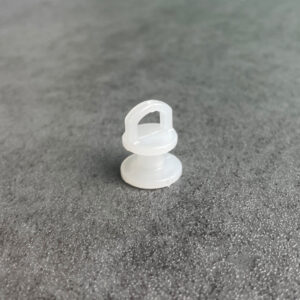
This triple curtain track sits in the curtain tracks and rails range. Two curtains instead of three is the PVC double curtain track; one is the PVC single curtain track. Runners for all three channels are in the curtain runner category, and the white plastic runner is the matching part.









 Esperanto
 English
 Arabic
 Russian
 French
Recenzoj
Ankoraŭ ne estas recenzo.