


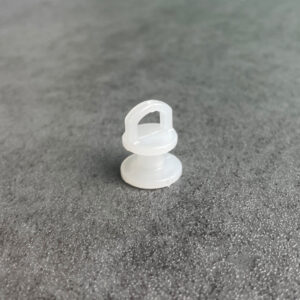
A plastic adjustable curtain hook does one thing a fixed hook cannot: it lets the hanging point move. The prong goes into the pocket of the pleat tape as usual, and the hook sits in a notched slot so it can be set higher or lower after the curtain has already been made up.
That matters less to someone choosing a hook for one window than to the people who make and fit curtains for a living. One part covers a range of drops, a heading can be levelled on site rather than in the workroom, and a tape that was sewn a little long stops being a remake.
What the notches are for
The slot in the body carries a row of stops. Move the hook one notch and the panel hangs at a different height relative to the tape. The tape itself stays where it is on the track, so the bottom edge of the curtain rises or falls and nothing else on the window moves.
That is the adjustment an installer actually needs. Floor levels vary, ceilings are not parallel to them, and a tape is sewn by a person rather than a machine. Correcting the drop at the hook takes a minute per panel; correcting it in the heading means taking the curtain down and unpicking it.
One part instead of a range of lengths
A workroom working with fixed hooks has to carry several drop lengths, or accept that one length will be slightly wrong on some jobs. Adjustable curtain hooks fold that choice into a single line, and the fitter resolves the last few millimetres on site.
For a distributor the argument runs the other way and lands in the same place: one SKU on the shelf covering the drops that would otherwise need three or four, and no dead stock in the lengths that nobody ordered.
Setting a heading straight, in the right order
The mistake with adjustable curtain hooks is to tune each one as it goes on. That produces a heading that is right hook by hook and wrong as a run, because every correction is made against a different reference.
The order that works: hang the first panel, pick one notch, and look at the bottom edge against the floor. Once that notch is right, fit every other hook in the panel to the same notch. Then walk the run and correct only the hooks that are visibly out — usually a handful, usually at the ends.
The same rule covers a whole room. Set one window, then copy the notch to the others, then correct. The adjustment is there to absorb the tolerance between windows, not to replace a consistent setting.
Where plastic is the right material, and where it is not
White moulded plastic is the right choice more often than buyers expect. It does not rust, which decides the question in bathrooms, wet rooms and coastal projects — a plated metal hook fails at the tip first, where the coating is thinnest, and the rust marks the tape from the inside. Plastic has no coating to fail. It also does not mark pale fabric, and it is light enough that a full heading does not pull the tape out of shape.
Where it is not the right choice is under real weight. Plastic curtain hooks creep under a sustained load, so a heavy lined drape hanging from one will slowly lose its setting over a season, and the heading that was level at handover will not be level a year later. For that work the metal pin hook is the correct part, and it is worth saying so rather than selling adjustable curtain hooks into a job they will not hold.
Which tapes and runners they suit
These are for pleat tape — pencil pleat, triple pleat, pinch pleat, goblet — where a tape is sewn along the top of the curtain and the heading is gathered by cords. The prong goes through the pocket from the back of the heading, the same way as any pin hook.
They are not for wave or S-fold headings, which hang from carriers at fixed spacing and have no gathered tape to pierce. If a wave heading is specified, the answer is a runner rather than a hook, and sending hooks against that order is a return waiting to happen.
Changing the drop later
The practical value of the notch shows up months after installation, when a customer decides the curtain is hanging too low over a radiator or wants a little more clearance above the floor. With a fixed hook that is a workroom job. With adjustable curtain hooks it is a step ladder and two minutes, and the tape is not touched.
The same applies to a change of flooring or a re-level of a floor — the drop can be corrected without remaking anything, which is the sort of thing that keeps a repeat customer.
Packing and supply
Adjustable curtain hooks are supplied white, loose in bulk and counted by weight, with bagging to the count the order asks for. For a distributor that means a box that can be split into counter packs; for a workroom, a box sized to the job rather than to the pallet.
If the hooks are going into a retail bag with a printed header, say so when ordering — the count per bag is fixed before the goods leave, and repacking afterwards costs more than the parts.
Questions buyers ask
Are adjustable hooks as strong as fixed ones?
For sheers, voiles and medium-weight curtains, yes — the load is well within what the moulding takes. For heavy lined drapes the honest answer is no: plastic creeps under sustained load and the setting will drift over a season. Match the hook to the curtain weight rather than to the price.
Can the drop be changed once the curtain is hanging?
Yes, and that is the whole point of adjustable curtain hooks. Move the hook to a different notch and the panel hangs higher or lower against the same tape. No unpicking, no re-sewing, no second visit from the workroom.
Do they fit any pleat tape?
Most pleat tapes suit plastic curtain hooks, but pocket depth and the tightness of the weave vary between them. A hook that seats well in a soft three-pocket pencil pleat tape can be tight in a stiff, densely woven one. Send the tape specification with the order and the match is checked before packing.
Will they work with a wave heading?
No. Wave and S-fold headings hang from carriers at a fixed spacing and have no gathered tape, so there is nothing for a prong to go into. Those headings take a runner instead, and the adjustable hook has no role in them.
Do they discolour in sunlight?
White moulded parts are the most exposed to it, and a heading in a south-facing window with the curtain permanently drawn back sees a lot of light. If the installation is in that position, say so at the order stage rather than finding out after the first summer.
Related products
These plastic adjustable curtain hooks are filed under curtain rod and track accessories. Where the curtain is too heavy for plastic, the metal curtain pin hooks are the fixed-drop alternative. The runners they hang from are in the curtain runners category, and a rail to hang them on is in the curtain tracks and rails range — the sliding curtain track for a plain hand-drawn rail, or the corded curtain track where the rail is out of reach. The S-fold wave curtain track shows the heading that takes carriers instead of hooks.









 Arabic
 English
 Russian
 French
 Esperanto
المراجعات
لا توجد مراجعات بعد.