

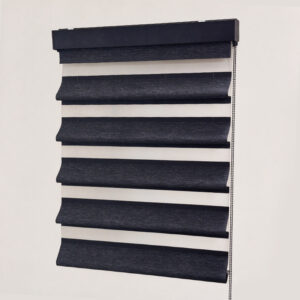


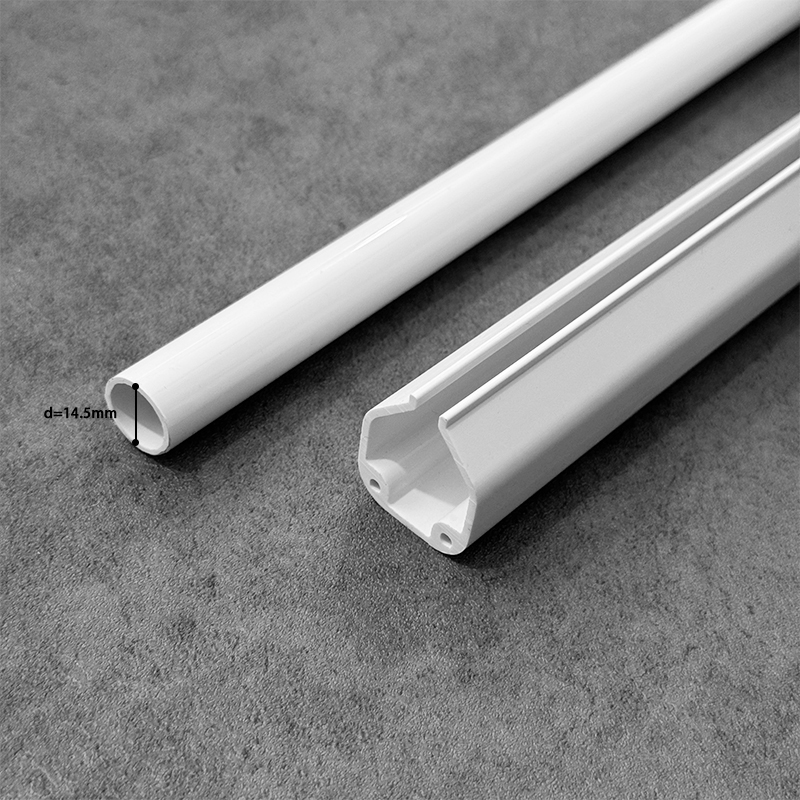
A roller blind cassette is the housing that covers the roll of fabric at the top of a blind and gives the window a straight, closed line instead of an open roll of fabric. This one is extruded in PVC and supplied for zebra blinds, with the top rail and the bottom rail in the same set — so the two profiles, the finish and the end caps all match before anything is assembled.
R&C supplies it as a component, not as a finished blind. The buyers are blind fabricators and distributors who assemble their own, which is why the set is put together as a pair rather than sold piece by piece.
What the cassette does that an open roll does not
Three things, and fabricators are usually buying all three at once.
It hides the roll. An open roller shows the fabric wound on the tube, and the diameter of that roll changes as the blind comes down. A cassette covers it, so the blind reads as one straight band at the top whatever position it is in.
It closes the light gap. The gap between the top of a blind and the ceiling is where the light gets in first, and on a blackout blind it is the detail that decides whether the customer is satisfied. A cassette closes over the top of the fabric rather than leaving it hanging below a bracket.
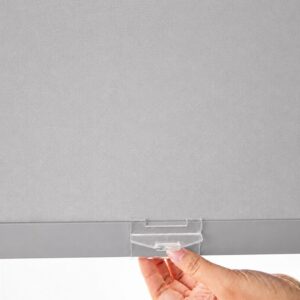
It gives the blind a finished edge. The bottom rail does the same job at the other end: it weights the fabric so it hangs flat and runs straight, and it finishes the hem so the blind does not look cut off.
Why PVC rather than aluminium
Aluminium cassettes are stiffer, and on a very wide blind that stiffness is worth paying for. On the widths most zebra blinds are made in, PVC does the job and brings four things aluminium does not.
The colour runs through the profile rather than sitting on it as a coating, so there is no paint edge to chip at a cut end — which matters on a component that gets cut to length. It does not corrode, so a bathroom or a kitchen blind does not develop white bloom along the profile. It is lighter, which reduces the load on the brackets and on the fabric at the top of the roll. And it is quieter: an aluminium cassette can drum when the blind is operated, where PVC deadens it.
The honest limit for a PVC roller blind cassette is span. Past a certain width, a PVC cassette will bow under its own length and the fabric will start to rub; that is where an aluminium profile takes over. Say the width at the enquiry and the answer comes back with which one to use.
Top rail and bottom rail as a matched set
Buying the two ends of a roller blind cassette separately is how a blind ends up with a cassette in one white and a bottom rail in another, or with end caps that almost fit. Supplying them as a set from the same extrusion run removes that risk, and it means the profiles are designed to work with each other — the same section, the same finish, the same clip detail.
It also simplifies the stock question. A fabricator holds one reference per width band rather than two, and a replacement rail is ordered against the cassette it belongs to.
Sizing a zebra blind cassette
A zebra blind on a roller blind cassette is not a single thickness of fabric on a tube. It carries two layers that pass each other as the blind moves, plus the roller that takes them up, plus a bottom rail that has to weight both layers. The cassette has to be deep enough to hold all of that without the layers touching as they travel.
That is the measurement that goes wrong most often: a cassette sized for a plain roller blind is not automatically deep enough for a zebra. The fabric rubs, the edge frays, and the fault appears weeks later as a scuffed band rather than as a fitting error.
The same logic applies at the bottom. A rail that is too light lets the fabric drift and creases along the fold; one that is matched to the fabric weight runs straight and keeps the bands aligned, which is the whole point of the zebra pattern.
Where these sets go wrong on site
A roller blind cassette that is too shallow. Covered above, and the most expensive to discover late, because by then the fabric is cut.
End caps from a different profile. They look close enough to fit until the blind is operated, then the fabric catches on the joint.
Cutting without allowing for the cap. The finished width is the fabric width plus the cassette ends, and a rail cut to the fabric width comes up short once the caps are on.
A bottom rail lighter than the fabric needs. The blind hangs, but it does not hang straight, and no amount of adjustment at the brackets fixes a rail that is underweight for the drop.
Finish, and what a fabricator should specify
White is the standard finish, and it is what most blind work uses because it disappears against a white ceiling and a white window reveal. Where a blind is being matched to a coloured fabric or a dark frame, the finish needs to be raised at the enquiry rather than assumed.
What to send with an order: the finished blind width, the fabric weight and whether it is a two-layer blind, and whether the cassette is going onto a wall bracket or a ceiling fix. Those four answers decide the profile, the rail and the end caps.
Packing and supply
Supplied as a rail set — the cassette and the bottom rail together — cut to length or in stock lengths depending on the order, with the end caps matched to the profile. For a fabricator working to a production schedule, stock lengths that are cut in-house are usually the better arrangement; for a distributor selling on to installers, cut-to-length sets remove a step.
If the sets are going into retail packaging as a blind kit, say so when ordering — the packing and the labelling are set before the goods leave.
Questions buyers ask
Is this the same as a roller blind cassette?
The format is the same as any roller blind cassette — a housing over a roller tube — but the depth is set for a two-layer zebra blind rather than a single fabric. A cassette built for a plain roller blind will not always clear the two layers of a zebra, which is why the two should not be specified interchangeably.
Does the set include the roller tube?
The set is the top cassette and the bottom rail, matched as a pair. Tubes, brackets and the operating mechanism are specified alongside it rather than included by default, so say what the blind is being built around and the rest is quoted with it.
Can it be cut to a different width?
Yes, that is normal for a component sold to fabricators. Allow for the end caps when cutting — the finished width is wider than the fabric, and a rail cut to the fabric width comes up short once the caps are fitted.
Will it take a motorised blind?
The cassette carries the roll and the fabric; the drive is a separate question of tube and motor, and a motorised build usually needs more internal clearance than a manual one. If the blind is motorised, say so at the enquiry rather than after the profiles are chosen.
What widths suit PVC rather than aluminium?
PVC covers the range most zebra blinds are made in, and it is the cheaper and more forgiving option there. On wide spans a PVC cassette bows and the fabric begins to rub, and aluminium takes over. Send the finished width with the enquiry and the choice is made on the number rather than on preference.
Related products
This roller blind cassette is the component side of the zebra blinds range, which includes the double layer day and night zebra blind, the manual day and night zebra roller blind, the motorized zebra blind in a heavier fabric, the zebra roller blind for home and the zebra roller blind for the living room. The rest of the blind range, including roller and Roman, is under window roller blinds.







 English
 Arabic
 Russian
 French
 Esperanto
Reviews
There are no reviews yet.