



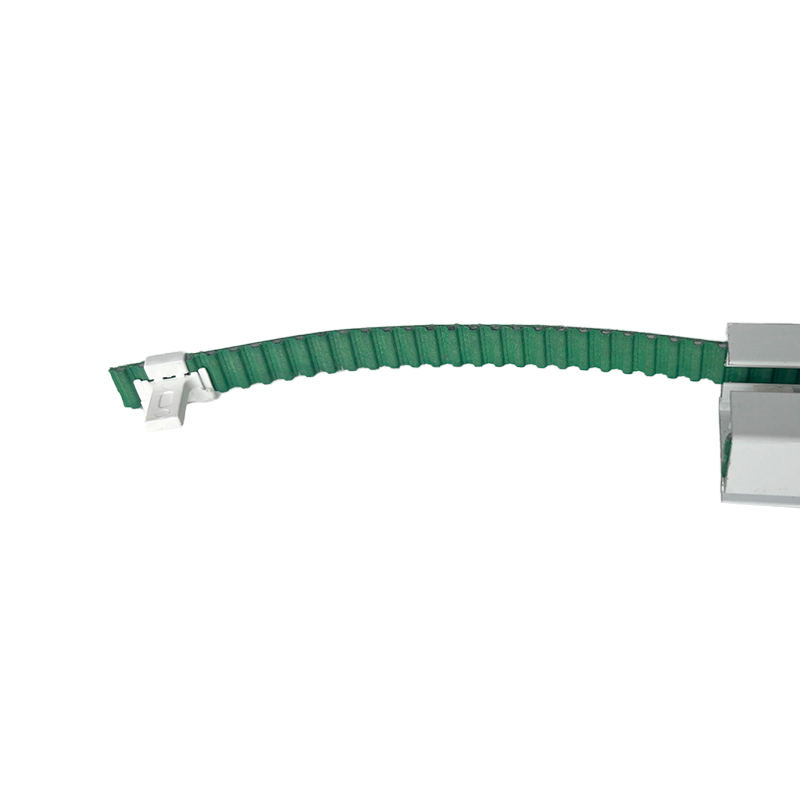
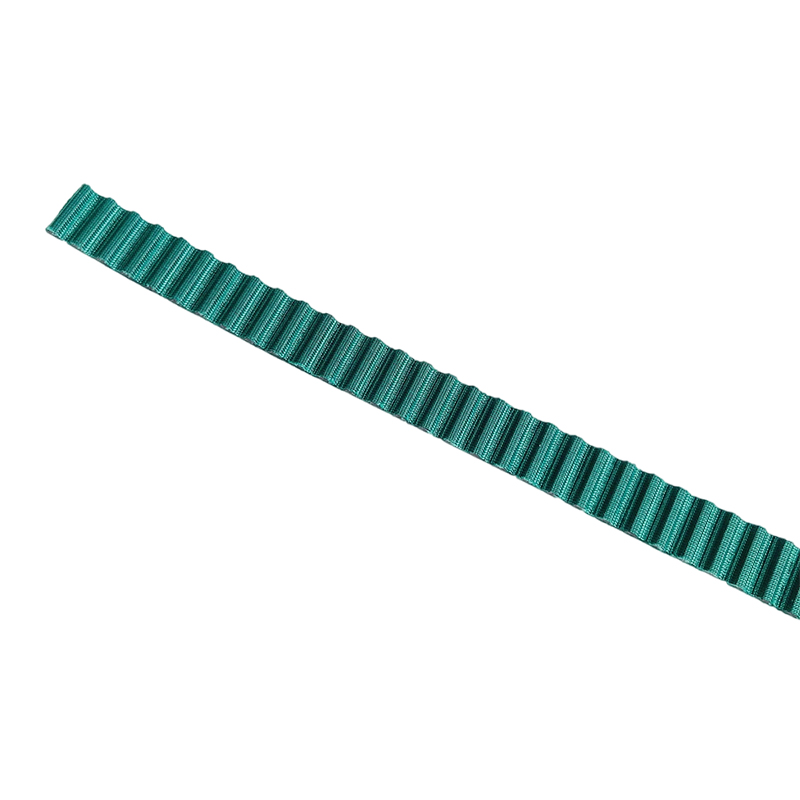
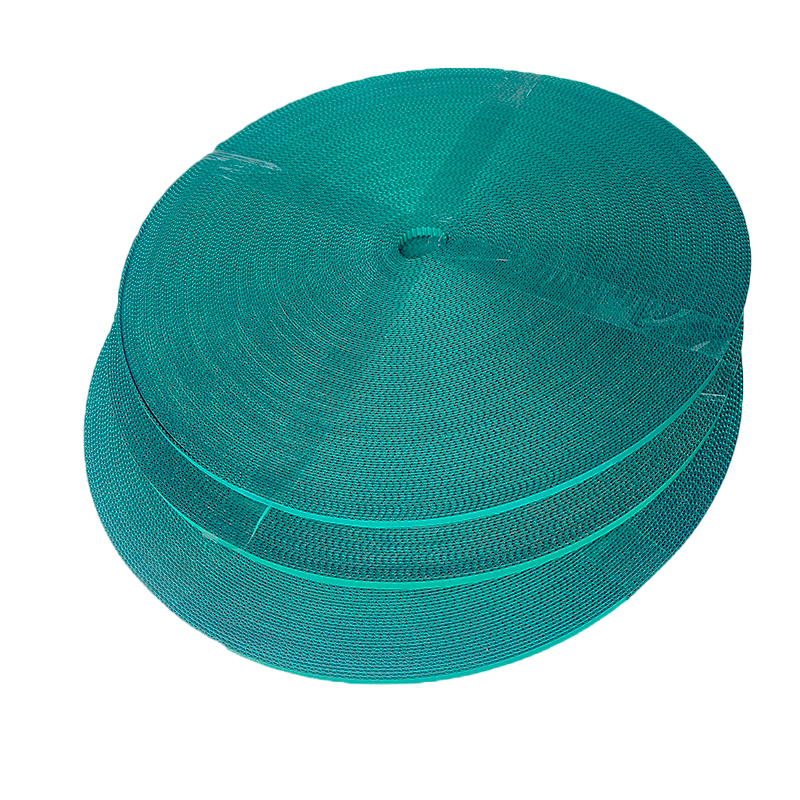
A curtain track belt is the toothed drive belt that runs inside a motorized curtain rail and carries the curtain carriers along it. The motor turns a drive pulley, the pulley engages the teeth, and the belt pulls the leading carrier. R&C supplies it as green toothed belting with metal connectors, coiled or cut to length.
This motorized curtain belt is a spare part, not a finished product. It is bought by track manufacturers building their own systems, by installers replacing a belt that has stretched or snapped, and by distributors keeping stock for the electric tracks they sell.
What the belt does in a motorized track
A curtain track belt is the only part of a motorized track that touches everything. It runs the length of the rail, loops around the drive pulley at the motor end and the idler at the far end, and carries the master carrier that the curtain hooks onto. Every opening and closing of the curtain is the belt moving through that loop.
Because it is inside the extrusion, a curtain track belt is also the part that fails without being seen. A belt that has stretched does not look broken — the curtain just starts to stop short of the end, or the motor runs on after the curtain has arrived. Diagnosing that is most of what this page is for.
The toothed profile — why it does not slip
The teeth are the reason this is a drive belt rather than a plain strap. A flat belt relies on friction between itself and the pulley; as soon as the load goes up or the belt gets a film of dust on it, friction gives way and the pulley turns without moving the belt. Teeth do not have that problem — each tooth sits in a groove and the drive is positive.
On a curtain track that matters for a second reason: position. A toothed belt moves a fixed distance per revolution, so the motor knows where the curtain is by counting turns. A slipping flat belt loses that reference, and the track starts stopping in the wrong place.
The teeth run on the inside face. The outside is smooth, which is what lets the belt slide through the channel without wearing the extrusion.
Signs the belt needs replacing
A curtain track belt does not usually snap without warning. The common sequence is:
- Stopping short. The curtain no longer reaches the end of the track, or reaches it on one side and not the other
- Running on. The motor keeps turning after the curtain has stopped, because the belt is no longer gripping the carrier
- A regular click or knock. Usually a tooth worn to the point where it skips a groove under load
- Slack on the return run. A belt that has stretched shows a visible sag on the side that is not under tension
- The connector has opened. The metal joint that closes the belt into a loop has come apart, and the belt is no longer continuous
Any of these points at the curtain track belt before it points at the motor. Replacing a motor when the belt was the problem is the most expensive way to learn this.
Measuring for a replacement
A curtain track belt is ordered by its loop length, not by the length of the track. The two are not the same, and quoting from the track length is how buyers end up with a belt that is short.
The reliable method is to take the old belt out and measure it laid flat, end to end, including the connector. If the old belt has stretched, measure the track run instead and add for the loop around both the drive pulley and the idler — the belt has to travel out and back, so the loop is roughly twice the rail plus the pulley circumference.
If the belt has snapped and part of it is missing, send the track model and the rail length rather than a measurement. It is faster to match the original build than to reconstruct a length from a fragment.
The connector and joining the belt into a loop
A curtain track belt arrives as a length, not as a closed loop. The metal connector at each end joins it into a loop on site, and that joint is the point where most field failures happen — either because it was fitted the wrong way round or because it was closed without the belt ends properly aligned.
The connector is also what allows a belt to be replaced without dismantling the track. The old belt is cut out, the new one is fed through the channel and around the pulleys, and the two ends are joined in place. On a long run that is a two-person job simply because the belt has to be held at both ends.
Spare connectors are worth keeping in stock. They cost very little and a track that is down for want of one connector costs a client relationship.
Coil or cut length
Two ways to buy, depending on who is buying. Manufacturers and distributors take coils and cut to the lengths their own builds need. Installers replacing one belt on one track take a cut length matched to that track.
Coils of curtain track belt are the cheaper way to buy per metre and the sensible way to hold stock if you build or service more than a handful of tracks a year. Cut lengths are the sensible way to buy if the next belt you need is a year away and you would rather not hold inventory.
Questions buyers ask
Will this belt fit another manufacturer’s track?
Only if the tooth pitch and the channel match. Tooth pitch is what determines whether the belt engages the pulley at all, and it is not standard across the industry. Send the track make, model and a photo of the old belt alongside a ruler and it can be matched — guessing from the track width alone does not work.
How often should a belt be replaced?
There is no fixed interval, because it depends on how often the curtain moves and how much load it carries. A hotel window that opens twice a day lasts far longer than a conference room that cycles hourly. Replace on symptoms rather than on a schedule.
Can the belt be shortened on site?
The belt can be cut, but cutting it changes the loop length and the connector has to be refitted at the new end. On a toothed belt that is a clean job if the cut is square to the teeth. It is not something to do with a pair of scissors on a ladder.
Does the belt come with the connector?
Connectors are quoted as a separate line so the quantity matches the number of belts rather than being assumed. A belt shipped without a connector is not usable until one arrives.
Is this belt for a straight track only?
It runs in straight and curved channels, but a curved run needs the belt to follow the bend without the teeth binding. Send the radius with the enquiry — a curve tighter than the belt can follow is the one case where the answer is no.
Related products
This belt belongs to the curtain rod and track accessories range. It is the drive part for the electric tracks in the curtain tracks and rails category — see the extendable motorized curtain track and the electric curtain track with LED light for the tracks it runs in. Carriers and runners for the same channel are in the curtain runner category.







 Russian
 English
 Arabic
 French
 Esperanto
Отзывы
Отзывов пока нет.