


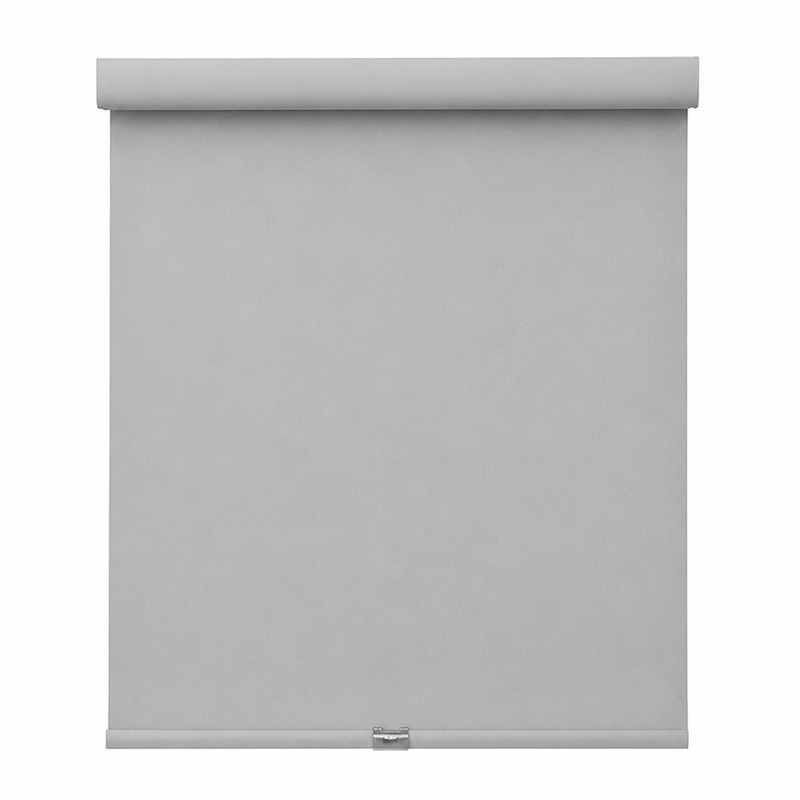
A roller blind is the plainest window covering there is: one piece of fabric on a tube, coming down over the opening and stopping wherever it is left. This one keeps that and takes away the two things people complain about — the chain at the side, and the four holes above the window.
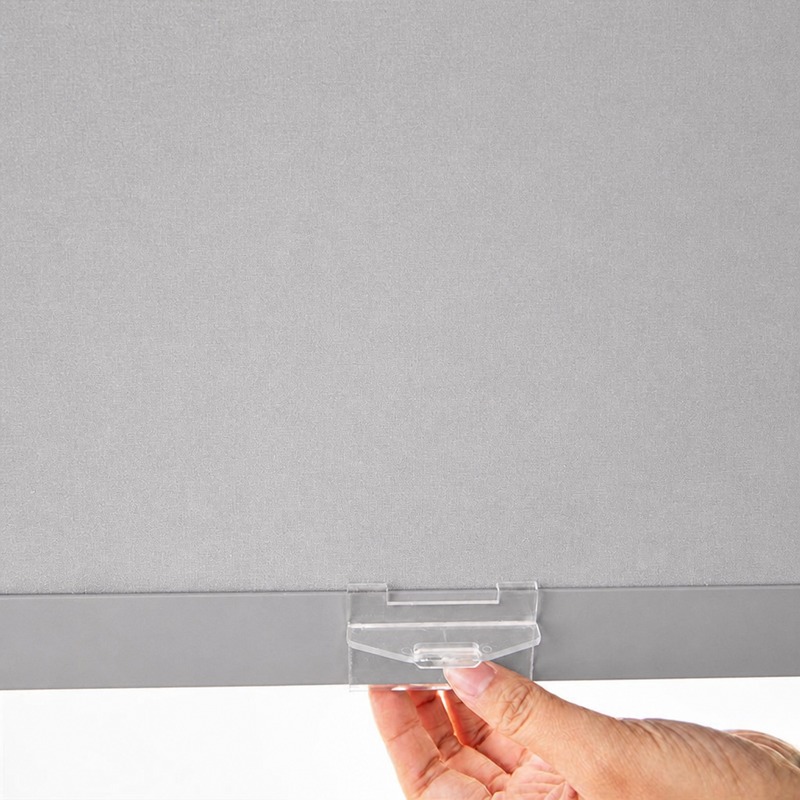
The blind is cordless. You pull the bottom rail down to lower it; a short pull on the rail releases the fabric and it rolls back up on its own. There is no chain loop hanging beside the window, nothing to hook onto a cleat and nothing for a child to reach. The fixing is the second change: the blind mounts to the window without screws or wall plugs going into the wall, so the frame is left as it was found.
R&C supplies no drill roller blinds to order in six colours, with the headrail and the bottom rail finished to match the fabric rather than in a single white. They go to distributors, fitters and property suppliers as well as to individual buyers.
Why no drill roller blinds exist in the first place
A roller blind is normally fixed with two brackets, and those brackets are normally screwed into the top of the recess or into the window frame. That is four holes, four plugs and a drill, and on a lot of windows it is the hardest part of the job rather than the blind itself.
The obvious case is a rented flat: a tenant cannot put four holes above a window and expect the deposit back, and a blind that comes off leaving the frame as it was found is the only kind that makes sense. The same applies to student accommodation, serviced apartments and holiday lets, where a window has to be re-blinded between guests without a maintenance visit and a tub of filler.
The second case is the wall — tiled reveals, concrete lintels, steel frames, old plaster that crumbles when a drill touches it — and the third is anything with a lease shorter than the blind: shop windows, show homes, pop-up units, exhibition stands.
It is worth knowing that the name changes with the market: in the UK these are sold as drill free roller blinds, in the US as cordless. The blind is identical and the fixing is identical — only the wording on the box changes.
How no drill roller blinds fix, and where that stops working
No drill means what it says: the blind is held to the window without a screw going into the wall. Nothing is drilled, nothing is filled afterwards, and the blind lifts away again when it is time to move.
With no drill roller blinds, where the blind lands is decided by how it is mounted. Inside the recess, the fixing sits against the top of the reveal; over the face of the frame, it sits on the frame itself. Those are different surfaces, and on a no drill blind the surface is the whole installation — so the mount has to be decided before the blind is cut, not after.
Where it stops working. A fixing is only as good as the surface under it. Rough render, loose plaster, a frame with a deep chamfer and a reveal that is not square are the cases where any surface fixing struggles, and no drill does not mean no preparation. Say what the window is — uPVC, timber, tile, plaster or metal — when the blind is quoted, and the fixing is matched to it rather than guessed at on site.
What changes when the chain goes
On a normal roller blind the chain is the operating part and the part that causes trouble. It tangles, it jumps the sprocket, it hangs in a loop that has to be kept out of reach, and in the UK and EU it has to be supplied with a device that keeps that loop high or breaks it under load — a device that has to be fitted correctly at the same time as the blind. Cordless roller blinds take that whole checklist out of the installation.
None of that exists here: no chain to tension, no sprocket to wear, no loop to secure, no cleat beside the window. The blind has one mechanism instead of two, and the window reads as a clean rectangle with nothing hanging off the side.
The honest limitation. A cordless blind is operated at the bottom rail, which means reaching it. On a normal window that is nothing; on a window with a very high head — a stairwell, a double-height room, a shopfront — the rail may be out of reach, and that is the one case where a chain still earns its place. Say the head height at the enquiry rather than after the blind is made.
Because the mechanism is set at manufacture for the size and the weight of the fabric, a cordless blind should not be trimmed on site. Cutting one down changes the load the spring sees and the balance the blind was built around. Order the width.
One solid fabric, and what that does to the window
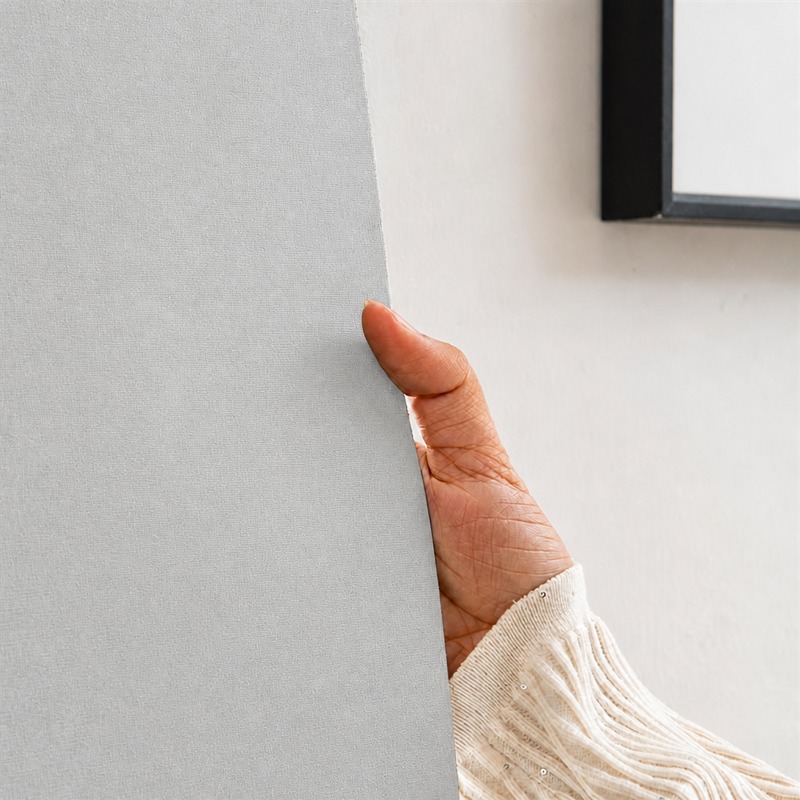
The fabric on no drill roller blinds is a single layer, not a patterned one: there is no band line to keep straight and nothing sheer in the middle of the window. Down, it covers the opening completely; up, it rolls away into the headrail and leaves the window clear.
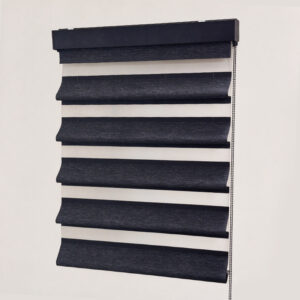
That difference matters at night. On a blind with a sheer section, a room with the light on can still show shapes from the street; a solid fabric does not. For a ground-floor living room or a bedroom that faces a road, that is usually the reason a roller blind is chosen over a zebra in the first place — and if the pattern is what you want instead, the same blind is available as a cordless zebra blind with the same no drill fixing.
On light control, be clear about what a roller blind is: the fabric comes down over the opening and the room darkens by degrees as it does. How dark is decided by the fabric, not by the fixing or the mechanism — so if a room needs a true blackout, say so at the enquiry and the answer will be about the fabric.
Six colours, and rails that match the fabric
The blind is made in six: white, off-white, cream, sand, light grey and charcoal — a graduated set rather than six unrelated shades, so one colour can carry through a property or a single room can move a step warmer without changing the product.
- White and off-white — where the blind should disappear into a white frame and the treatment is meant to be invisible.
- Cream and sand — the warmer end; softens a north-facing room that already reads cold.
- Light grey — the safe specification for a rental or a resale; suits almost any wall colour.
- Charcoal — the strongest line against a pale wall, and the one that hides street grime on a ground-floor window.
The headrail and the bottom rail are finished to match the fabric. Most roller blinds at this level carry a white headrail whatever the fabric is, and a white bar above a charcoal blind is a visible break at the top of the window; here the rail reads as part of the blind. The bottom rail is weighted to keep the fabric hanging flat and to give the blind something to be pulled by.
Measuring, and what to send with an enquiry
Width. Measure the recess at the top, the middle and the bottom. Frames are rarely square and the three numbers will differ by a few millimetres; quote the smallest, because a blind that is too wide will not fit the tightest point.
Drop. From the top of the recess to the sill if the blind sits inside the recess, or to where you want it to finish if it hangs over the frame.
Mount. Inside the recess or over the face of the frame — on a blind that fixes without drilling this decides which surface the fixing lands on, so it has to be settled before the blind is cut.
Then send the frame type — uPVC, timber, tile, plaster or metal — and the colour. With those five answers no drill roller blinds can be cut, the fixing matched and the quote issued without a second round of questions.
For distributors, fitters and landlords
No drill roller blinds are supplied cut to order, headrail and bottom rail matched to the fabric, fixing included, in the six colours. Packaging can be set for retail or for trade, and own-brand labelling is available — both decided when the order is placed rather than afterwards.
Two things worth building into a no drill range. Spare fixings: the fixing is the part that gets lost in a move or asked for two years later, and a distributor who can post a replacement keeps the customer. Batch consistency: for a block of flats or a hotel, order the whole block at once and the shades come off the same dye lot rather than being matched later.
Care
Cleaning no drill roller blinds is the same job as any roller blind: dust the fabric with a soft brush, or a vacuum on low with the brush head. Marks come off a damp cloth with a mild detergent, worked gently — roller fabric will mark if it is scrubbed. Let the blind dry fully before it is rolled back up, because fabric rolled away damp is how a blind ends up with a crease that never comes out.
Check the fixing a few weeks after installation, and again at the change of season if the window takes a lot of sun. One that has started to lift is worth re-seating, and the blind should come down before a move rather than be pulled off with the rails.
Questions buyers ask
How do you raise a roller blind with no chain?
Cordless roller blinds are operated at the bottom rail: pull it down to lower the blind, and a short pull releases the fabric so it rolls back up. Nothing has to be unhooked, and there is no chain to hold while it moves.
Will it hold on my window without drilling?
That is the whole question with no drill roller blinds: it holds on the surface it is fixed to, so the answer is about the frame rather than about the blind. uPVC, timber and tile are straightforward; rough render, loose plaster and frames with a deep chamfer are not. Send the frame type and a photograph at the enquiry and the fixing is matched to it.
Can I cut it down myself?
No — and this is the difference between a cordless blind and a chain one. A chain blind can sometimes be shortened at the tube; cordless roller blinds cannot, because the balance lives in the mechanism and cutting it changes the load the spring sees. Order the width and the drop.
Does it black out the room?
That depends on the fabric, not on the blind. This is a solid fabric that covers the opening completely, which is what stops shapes being visible from the street at night. How much light it shuts out is a fabric question — say what the room needs at the enquiry and the answer comes back about the fabric.
Do I need a cord safety device with this?
There is none. No drill roller blinds have no chain loop, so there is no device to fit and nothing to fix beside the window. That is the reason most buyers move to a cordless blind for a child’s room in the first place.
Related products
These no drill roller blinds sit alongside the no drill honeycomb blind and the cordless zebra blind, which use the same fitting for a banded fabric. Motorised versions of the same blind are the motorized roller blind and the smart home blackout roller blind, and a lighter alternative for a living room is the Shangri-La blind. If the window is being built rather than bought, the housing and tube are supplied separately as a roller blind cassette set. The rest of the range is under window roller blinds, and wholesale or OEM quantities go through the enquiry form.





 Russian
 English
 Arabic
 French
 Esperanto
Отзывы
Отзывов пока нет.