

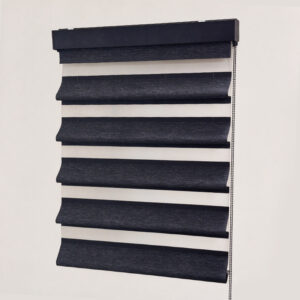

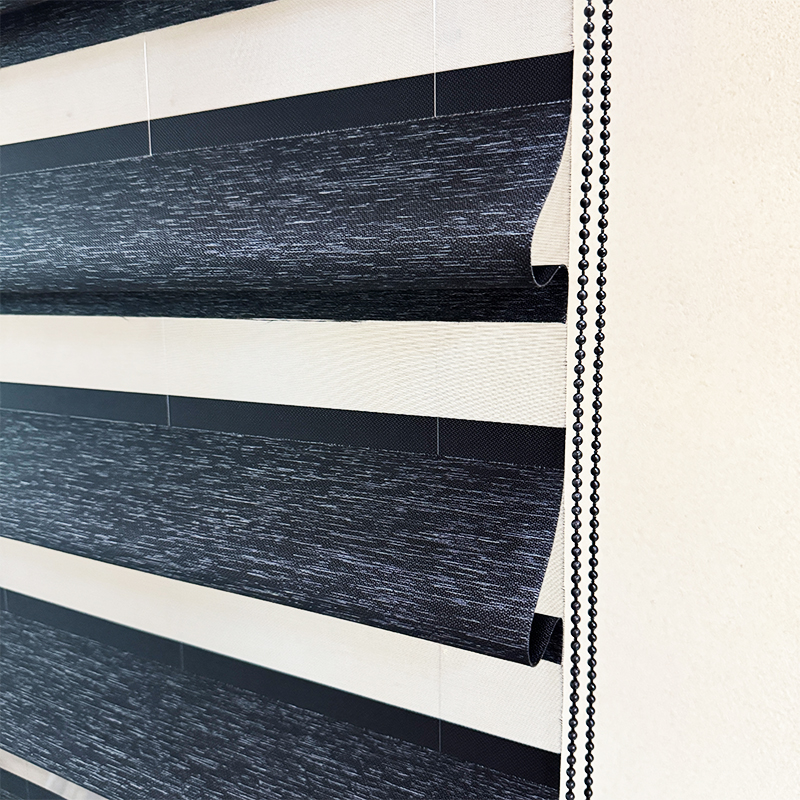
A black zebra blind is the same mechanism as any day and night blind: two layers of alternating band, one sheer and one opaque, passing each other as the blind moves. What changes with black is the contrast. In the open position the pale sheer sits in front of the dark band and the window behind shows through as a bright stripe, so the pattern reads harder than it does on a light-coloured blind.
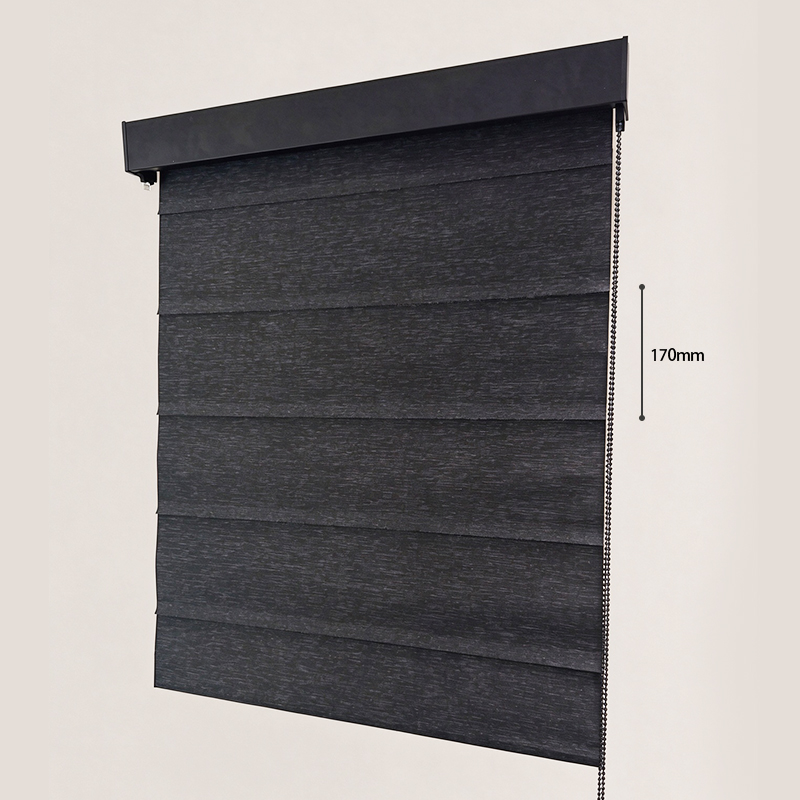
This one carries that through to the hardware: cassette, bottom rail and bead chain all finished in black, so the dark line runs from the ceiling to the bottom rail without a break.
R&C supplies black zebra blinds cut to order in a linen-look woven fabric, to distributors, fitters and property suppliers as well as to individual buyers.
What black does to the stripe
The stripe on a zebra blind is not printed. It is the sheer band letting the window through while the opaque band blocks it, and that is why the colour of a black zebra blind changes with what is outside.
Against a bright sky, the sheer band reads almost white and the contrast is at its strongest — this is the look most people are buying when they ask for a black zebra blind. Against a red brick wall or a shaded courtyard, the same band reads much darker and the blind goes quiet. That is worth knowing before the order, because a blind specified from a photograph showing a bright window will look different on a wall that faces something dark.
Closed, the bands slide over each other and the window disappears: one continuous dark surface with the band seams left as faint horizontal lines. Open, it is a striped blind. The two states are genuinely different rooms, and the blind is doing both jobs from the same rail.
The linen texture, and why it matters more in a dark fabric
A flat black fabric is the least forgiving surface in a window. Dust reads on it, finger marks read on it, and a mark left by a hand pulling the bottom rail stays visible until it is washed.
The woven linen-look face changes that. The surface is broken up by slubs and pale flecks, so light scatters across it instead of sitting on it, and a mark that would stand out on a flat black sits inside the texture instead. It also means the blind does not read as jet black from across a room — it reads as a dark charcoal with movement in it, which is usually what makes a black blind work in a room that is not itself dark.
That texture is the reason this blind is specified for living rooms and bedrooms rather than for a utility window. It is a fabric choice, not a coating, so it does not crack or lift at a fold.
Black hardware, not black fabric on white fittings
Most zebra blinds are built on a white cassette and a metal bead chain, and most black zebra blinds inherit exactly that, because the fittings are bought in whatever colour the line already uses. On a pale fabric nobody notices. On a black one it is the first thing you see: a bright bar across the top of the window and a bright line down one side, both fighting the fabric they are supposed to support.
Here the cassette, the bottom rail and the chain are finished to match the fabric, so the blind reads as one dark object from the ceiling down to the bottom rail. The cassette also covers the roll, which keeps the top of the blind a straight line instead of showing the fabric wound on the tube.
If you are buying the housing on its own to build blinds in-house, the same profile is supplied separately as a roller blind cassette set with the tube and bottom rail, and the finish has to be specified with it — a black cassette is a different line item from a white one.
How the bands move, and what each position is for
Aligned, the sheer band sits in front of the opaque band and the window reads almost clear — daylight in, view intact, and the pale stripe across the blind. Closed, the opaque band covers the sheer and the room darkens without being shut out completely. Every position in between is a setting rather than a state, which is the whole point of a day and night blind over a plain roller.
It is not a blackout blind. A zebra keeps a sheer band by design — that is where its range comes from. A black zebra blind looks dark when it is closed, and that is not the same as a blackout. A room that needs true blackout needs a different fabric build, and it is better said before the order than after it.
Where black zebra blinds earn their place, and where they do not
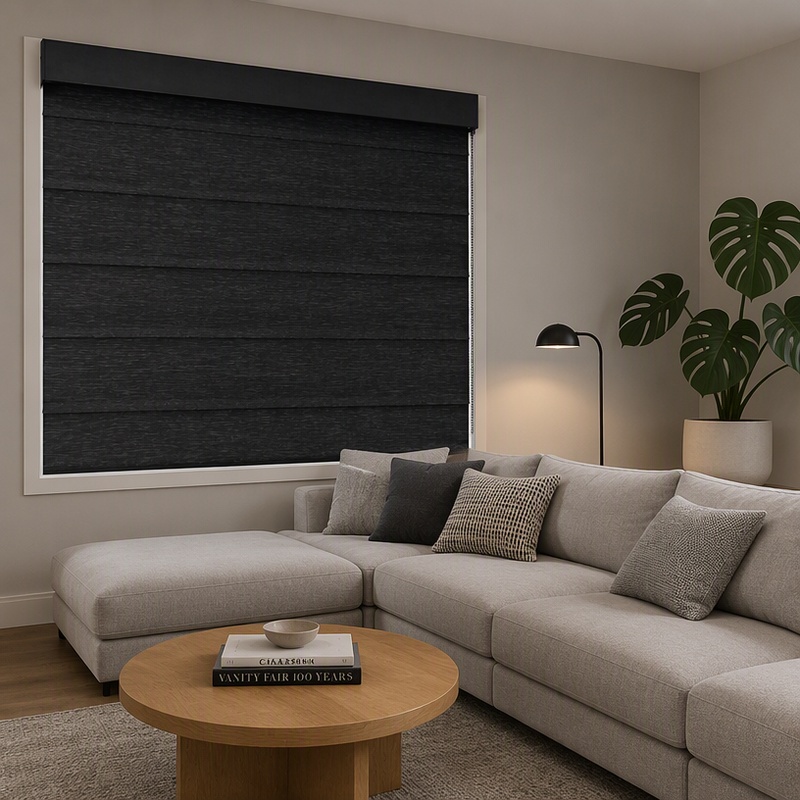
Against a dark wall or a dark window frame. The blind stops being an object on the wall and becomes part of the opening. This is the strongest use of a black zebra blind and the reason most of them are bought.
In a bedroom. Closed, it reads as a calm dark plane rather than a pattern; open, it gives a graphic stripe in the morning. It is a blind that looks different at night and in the day, which few fabrics manage.
In a rented flat with magnolia walls. The contrast is deliberate and strong. If the intention is a blind that disappears, this is the wrong choice — a light grey or an off-white does that job better.
In a small, north-facing room. A dark blind can read heavy. The linen texture softens it, but it is still a dark surface on a wall that gets little light, and that is a decision to make on purpose rather than by accident.
In a bright kitchen. This is where a dark fabric is least comfortable: cooking steam, dust and fingerprints all settle on a window, and they show first on black. It works, but it needs more cleaning than a pale blind on the same window.
Sizing, and what to send with an enquiry
Width. Measure the recess at the top, the middle and the bottom. Frames are rarely square and the three numbers will differ by a few millimetres; quote the smallest, because a blind that is too wide will not fit the tightest point.
Drop. From the top of the recess to the sill if the blind sits inside the recess, or to where you want it to finish if it hangs over the frame. A zebra has a fixed band repeat, so a small change to the drop moves where the bands land when the blind is closed. Say the finished drop rather than a round number and the blind is made to it.
Mount and chain side. Inside the recess or over the face of the frame, and which side the chain hangs. Both are set at manufacture; neither is worth changing on site.
Then send the frame type and the colour of the frame, so the black hardware is matched to what it is going against rather than chosen in isolation. With those answers black zebra blinds can be cut and the quote issued without a second round of questions.
Care
Dust is the whole job on black zebra blinds, and it is a job worth doing before it becomes visible. Brush the bands along their length with a soft brush, or run a vacuum on low with the brush head — brushing across the band rather than along it is how a sheer band gets pulled out of line.
Marks come off with a damp cloth and a mild detergent, worked gently and blotted rather than scrubbed. The sheer band is the delicate half; it marks if it is rubbed, and a mark on the sheer shows through the whole pattern. Let the blind dry fully before it is rolled back up.
Wipe the chain with a dry cloth rather than a wet one — a bead chain that stays damp collects dust in the links. Check the cassette fixings once a few weeks after installation, and again at the change of season if the window takes a lot of sun.
Questions buyers ask
Is a black zebra blind blackout?
No. A zebra is a day and night blind, and the sheer band stays sheer. Closed, this one reads as a dark surface, but light still comes through the sheer. If the room needs a true blackout, that is a different fabric and should be specified as one.
Will black make the room look smaller?
It makes the window read heavier, which is not the same thing. In a small room with pale walls, black zebra blinds are a strong horizontal band and they will be noticed; the linen texture keeps them from reading as flat black, which is what usually makes a dark blind feel like a hole in the wall.
Does black fabric show dust?
Black zebra blinds show dust more than a light fabric does, yes. A woven face hides more of it than a flat one, but a dark blind still wants brushing every few weeks, and more often in a kitchen or on a window that opens onto a road.
Which side does the chain go?
Whichever side is specified on the order. It is set at manufacture, so say left or right with the width and the drop rather than deciding at the window.
Can it be made to my exact size?
Yes — black zebra blinds are cut to order in width and drop. Send the smallest recess width, the finished drop, whether it mounts inside the recess or over the frame, and the chain side.
Related products
These black zebra blinds sit in the zebra blinds range with the custom size double layer day and night zebra blind, the manual day and night roller blind, the zebra roller blind for home, the motorized zebra blind in the same linen-look fabric, and the cordless zebra blind for a window that needs no chain at all. For a window being built rather than bought, the housing and tube come as a roller blind cassette set. The rest of the range is under window roller blinds, and wholesale or OEM quantities go through the enquiry form.







 Russian
 English
 Arabic
 French
 Esperanto
Отзывы
Отзывов пока нет.