


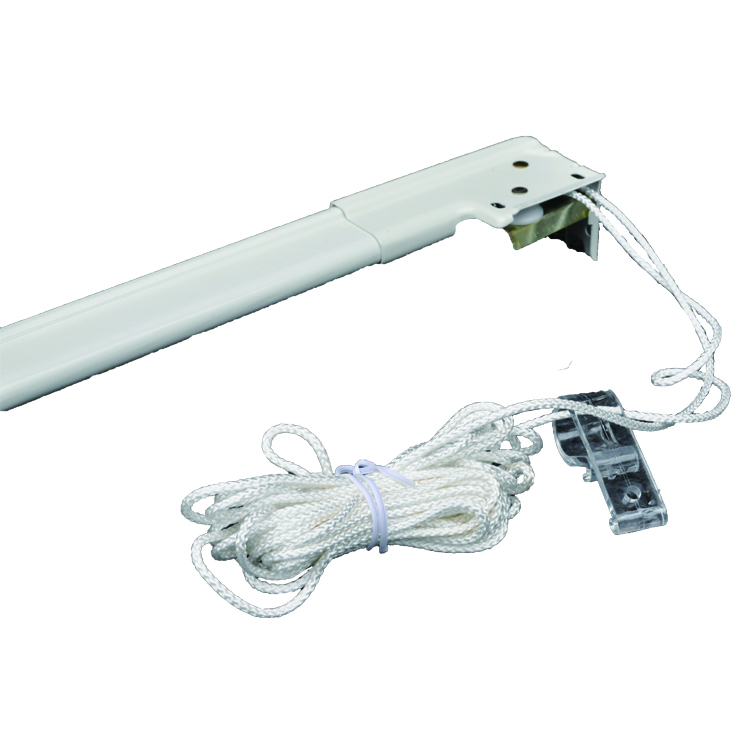

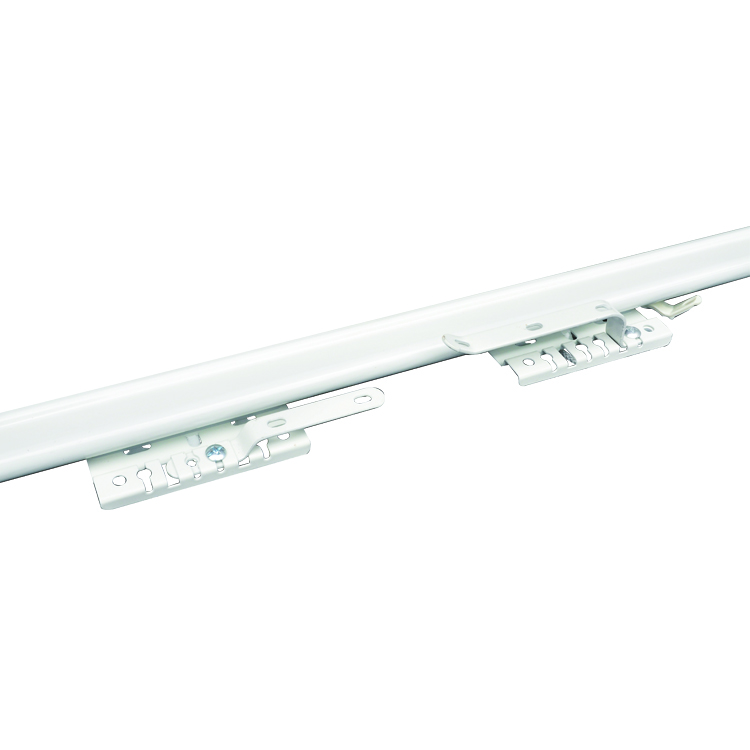
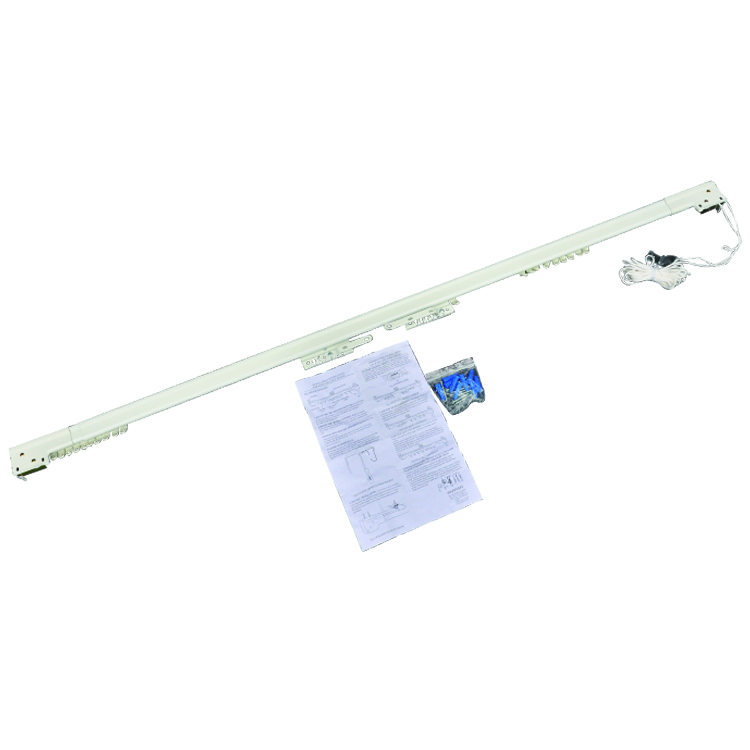
A corded curtain track draws the curtain with a pull cord instead of by hand at the rail. The cord runs as a continuous loop at one end of the channel, around a pulley, and back through carriers linked to it — so a light pull at chest height sends the curtain along the whole run.
R&C supplies it as a slim white aluminium channel with the pulley end assembled, the carriers already in the track, and the cord coiled with the gliders and hooks. It goes up on ceiling or wall brackets like any other track. The difference is only in how the curtain is moved.
In the trade this is often called an F track, after the shape of the section. Buyers in the UK and Ireland are more likely to ask for a corded track, buyers in North America for a cord-operated or pull-cord rail — it is the same part under three names.
What the cord actually does
The cord forms a closed loop at the pulley end of the channel. Both strands of that loop run out along the track to the leading carrier and come back, so the two halves hang together at the point where the operator stands. Pull on one and it travels; the other follows it.
The leading carrier is anchored to the cord. Draw on one half of the loop and the stack travels one way; draw on the other and it returns. The carriers behind it are linked to each other through the heading tape, so the whole stack moves as one and the curtain opens evenly from the pull end rather than bunching in the middle.
On a one-way draw the loop turns at the pulley end only and the curtain stacks to that side. On a two-way draw a return pulley at the far end brings the second half of the loop back, and the curtain opens from the centre. The two are different builds, not an option fitted on site, so the choice has to be made before the track is cut.
Two consequences follow from that arrangement on any corded curtain track, and both matter when specifying. The cord end has to be where a person can reach it, which is not necessarily where the window is. And the pull is only as smooth as the pulley, which is why the pulley end is assembled and tested rather than left to site.
Where a corded curtain track earns its place
A corded curtain track costs more than a plain one and less than a motorised one. The jobs where that middle position is exactly right are fairly consistent.
The rail is out of reach. High windows, clerestory glazing, a rail set above a tall door, a ceiling track in a double-height room. Nobody is getting a step ladder out twice a day, and a motor is more than the job asks for.
The curtain is over something you cannot stand on. Above a bath, a whirlpool, a kitchen island, a bed. Reaching across a bath to draw a shower curtain by hand is the classic case, and it is also the one where a corded track is safer than a motor — no power anywhere near water.
The window is behind furniture. A sofa or a desk pushed against the wall leaves no room to stand and pull. The cord drops at the clear end of the run and the problem disappears.
The room has no wiring and no appetite for it. Rental refits, heritage buildings, hospital and clinic privacy rails, hotel rooms being refreshed without opening the ceiling. A cord needs no supply, no remote, no battery to change and no commissioning.
Bays and angled runs. A corded curtain track can be bent through the corners of a bay and still driven from one point, so the whole bay opens with one pull. That is awkward to do by hand and expensive to do with three motors.
Cord hand, cord drop, and where the loop hangs
Four things have to be decided before the track is cut, and all four are settled by the room rather than by the product.
Draw. One-way, stacking to the pulley end, or two-way, opening from the centre. A centre-opening window that has to be drawn from one side is the mistake that shows up on the first site visit.
Hand. The pulley end is left or right as you face the window. Getting this wrong is not a small error — the track has to come back to be re-ended, or the cord hangs in the wrong corner for the life of the installation.
Drop. How far the loop hangs below the track. Long enough to be comfortable standing, short enough that it does not trail or tangle. On a high window the drop is usually longer than the track is deep, and it needs stating on the order.
Position. The loop hangs at one end of the run, so the end has to be clear — not behind a return wall, not inside a bay reveal, not where a wardrobe door opens into it.
Cord safety is not optional
A hanging cord loop is a strangulation risk, and this is the one part of the specification where the buyer’s market regulator has already made the decision for them. Most markets now require a corded product to be supplied with a tensioning device that keeps the loop taut, or a breakaway connector that releases under load.
Both do the same job: they stop the loop hanging free as an open noose. A tensioner is fixed to the wall or reveal and holds the cord tight; a breakaway clip separates if something catches in it.
For a trade buyer this is a compliance question rather than a design preference. Supplies that arrive without a tensioner get rejected at the border or pulled off the shelf, and a customer who fits one without it has installed a product that fails the same test. State the requirement on the order and it comes fitted.
Fixing it: ceiling or wall
The channel takes brackets at both faces, so the same corded curtain track goes flat to a ceiling or onto a wall above the window. On a ceiling it sits close to the slab and reads as a thin white line; on a wall it holds the curtain clear of the reveal.
The bracket spacing follows the span and the weight of the curtain, the same as any track — a long run with lined drapes needs more fixing points than a short one with sheers, because the pull of the cord puts load on the run in a way that hand-drawn curtains do not.
One detail worth passing to the fitter: fix the brackets and level the run before the cord is tensioned. A track that is out of line will still run, but the cord will feel heavy at one end and light at the other, and the customer will report it as a stiff track rather than as a fixing problem.
Carriers, runners and the parts in the bag
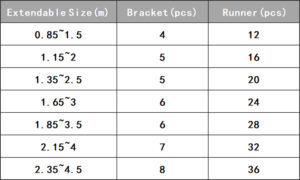
On a corded curtain track the carriers run inside the channel and carry the curtain hooks. The count follows the heading — a gathered heading needs more carriers than a wave or a pleat that is set at fixed intervals.
Supplied with the track are the gliders and hooks for the heading type ordered, plus the pulley end assembled and the cord. The carriers are already loaded in the channel, which is why the track arrives as a complete unit rather than as a length of extrusion and a bag of parts.
If the heading is a wave or a pleated heading with fixed carrier positions, say so at the order stage — carrier spacing is set in the factory and is much harder to change on site.
Ordering a corded track
To order a corded curtain track, give the finished length, the cord hand, the cord drop, and whether it is ceiling or wall mounted. On an angled run, give the shape of the bay and the corner positions.
Tracks are cut to length and packed per set, so a project order ships as complete units rather than as stock lengths. For a hotel or a clinic with a repeating window, send one window’s details and the quantity, and the rest follows from that.
These sit alongside the rest of the curtain tracks and rails range. Where the rail has to be driven rather than pulled, the extendable motorized curtain track is the next step up, and the flexible hospital curtain track covers the curved privacy runs a straight corded track cannot follow.
Questions buyers ask
Is a corded track the same as a cord-operated track?
Yes. Corded, cord-operated, pull-cord and cord-drawn all describe the same mechanism, and F track refers to the section of the channel. The naming split is regional rather than technical — UK and Irish buyers say corded, North American buyers say cord-operated, and both fit the same brackets and carriers.
Can it be fitted to a bay window?
Yes, and a bay is one of the better uses of a corded curtain track. The track is bent through the corners and the cord is run to one end, so the whole bay draws from a single point. Give the bay shape and the corner positions with the order so the bends are set before the track is cut.
How far below the track should the cord hang?
Far enough to pull comfortably without stooping, short enough that it does not trail on the floor or catch on furniture. On a high window the drop is usually longer than the track is deep. State it on the order — it is set when the cord is fitted.
Does it come with a child safety device?
A tensioning device or breakaway connector is supplied with the track, and it should be fitted as part of the installation. Most markets require one on any corded window product. If a specific market has its own requirement, say which market at the order stage and the right device is packed with it.
Can it be motorised later?
Not on the same corded curtain track. It is driven by hand and has no provision for a motor; the motorised version is a different channel with a belt and a drive unit. If there is any chance the job will be motorised later, specify the motorised track now — retrofitting means replacing the rail, not adding to it.
Related products
This corded curtain track is filed under curtain tracks and rails. For a straightforward hand-drawn rail in the same slim section, the sliding curtain track is the plainer option, and the S-fold wave curtain track covers the wave heading. Brackets for ceiling and wall fixing are in curtain track brackets, replacement runners in curtain runners, and the rest of the fittings in curtain rod and track accessories.









 English
 Arabic
 Russian
 French
 Esperanto
Reviews
There are no reviews yet.