

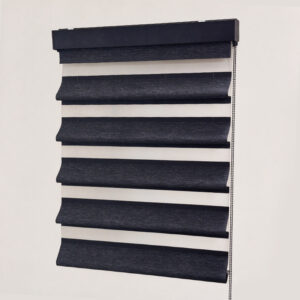
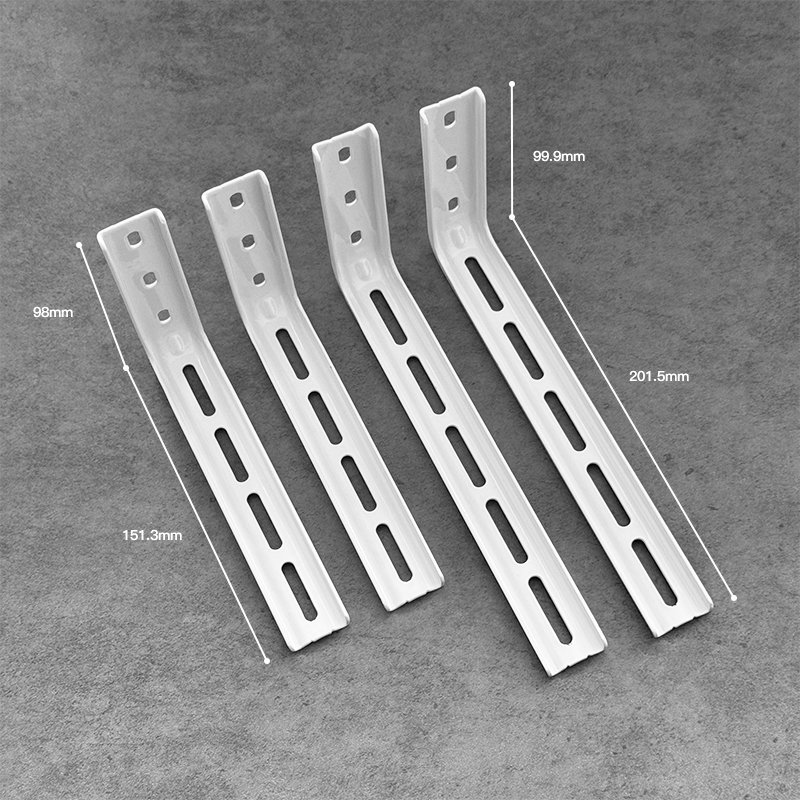


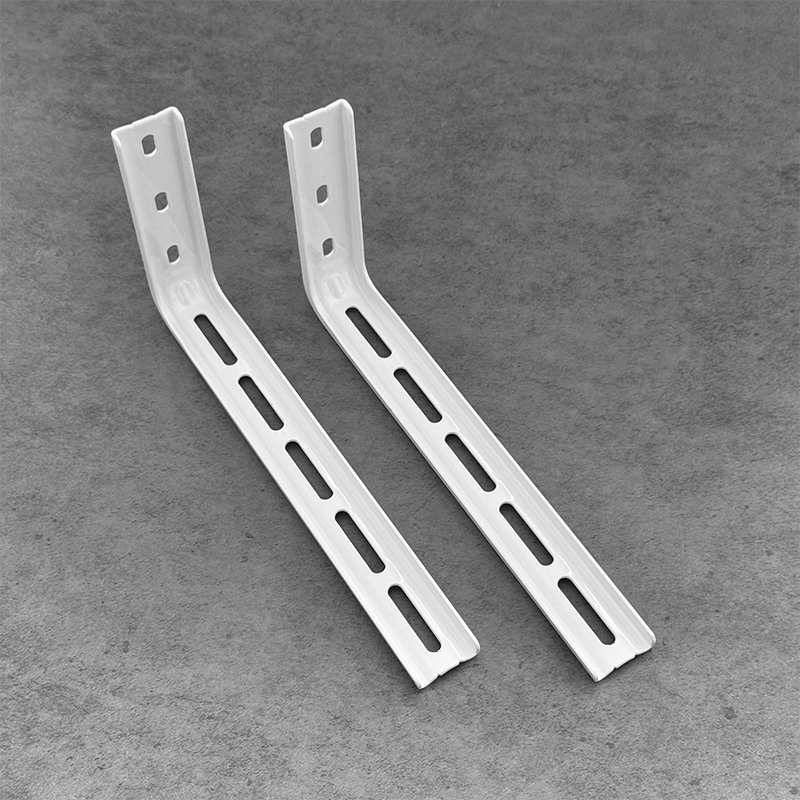
Curtain track brackets hold a rail below the ceiling instead of tight against it. Each bracket fixes to the ceiling at the short end and carries the track at the long end, so the rail hangs at a set distance below the slab rather than sitting flat on it.
R&C supplies them in white coated steel with slotted arms. They are the part that makes a track work in the rooms where a direct ceiling fixing does not — a high slab, a ceiling with a cornice, a plasterboard lid that needs the load spread, or a window where the curtain has to clear a radiator or a sill.
When a track needs brackets instead of a direct fixing
Most tracks can be screwed straight to the ceiling. Brackets are not an upgrade on that — they are the answer to four specific situations, and it is worth checking which one applies before quoting.
The ceiling is too high for the curtain. A rail fixed flat to a high slab leaves the curtain hanging from a point well above the window, and the gap above the heading shows. Brackets drop the track to a sensible height without changing the window.
Something is in the way. A cornice, a ceiling rose, a beam, a duct box, a curtain pelmet — all of them push the fixing line off the ceiling. The bracket arm reaches past the obstruction and puts the rail where the curtain needs it.
The ceiling cannot take a concentrated fixing. On a suspended grid or a soft plasterboard lid, spreading the fixing points out is often the only way to hold a track safely. Brackets give you that spread because the load goes down the arm rather than straight into the board.
The curtain needs to clear something. A radiator, a window that opens inward, a deep sill. Dropping the rail a little is usually cheaper than changing the window treatment.
Where none of those apply, a direct fixing is the better quote — fewer parts, less to go wrong, and nothing hanging in the room. Say so rather than selling brackets a job does not need.
What the slots are for
The long openings in the arm are not decorative and they are not weight-saving cut-outs. They exist so the track position can be adjusted after the bracket is already on the ceiling.
In practice that does three things. It lets a fitter square up a run of brackets that were drilled slightly off line, it compensates for a ceiling that is not level, and it allows the track height to be set on site rather than decided on a drawing. On a long run in an old building, all three happen at once.
The slot is also why brackets are more forgiving than a fixed plate — a mistake in the fixing position is corrected by sliding rather than by drilling a second hole next to the first.
Spacing, and how many to order
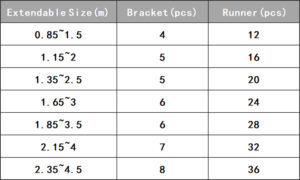
The number of curtain track brackets is set by the span and the weight of the curtain, not by a fixed rule per metre. A short window carrying sheers needs fewer than a long run carrying lined drapes, and the difference matters — an under-bracketed track sags in the middle exactly where the curtain is heaviest.
Two practical points that matter more than the count itself. Keep the end brackets close to the ends of the rail rather than setting them in, because the ends are where a track lifts when the curtain is pulled. And keep the spacing even, because an uneven run is visible from the floor even when nothing is wrong with it.
Send the rail length and what the curtain weighs, and the bracket count comes back with the cutting list. Ordering brackets by eye is how a job ends up one short on a Saturday.
Steel, coated white
These curtain track brackets are steel rather than plastic, which is what they need to be. A plastic bracket under a loaded track creeps over time and the rail slowly drops at the ends; steel holds its shape.
The white coating is there for two reasons: it matches the white track and the white ceiling, and it stops the arm from marking the plaster where it passes close to it. On a room where the rail is visible, coated brackets disappear against the ceiling in a way bare metal does not.
Bare steel is also the wrong finish in a bathroom or a kitchen, where condensation finds every unprotected edge. The coating is not cosmetic there, it is what keeps the part serviceable.
Fitting onto the track and the ceiling
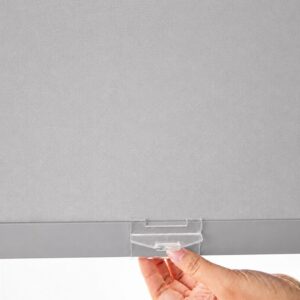
The short leg of a curtain track bracket goes against the ceiling and takes the screws or anchors. The long leg drops down and carries the track — either the rail sits on the arm and is screwed through the slot, or the arm engages the top of the extrusion, depending on the track profile.
Two things go wrong often enough to be worth stating. Fixing the brackets before the track is on site, so the spacing is set from the drawing rather than from the actual rail. And screwing the track to the bracket before the run is levelled, which locks in whatever error the ceiling had.
Fit the curtain track brackets, hang the track, check the run with a line, then tighten. That order takes an extra ten minutes and saves the callback.
These brackets are made for the tracks in the curtain tracks and rails range, including the PVC single curtain track and the double curtain track. For the powered versions, the extendable motorized curtain track uses the same fixing detail.
Questions buyers ask
How many curtain track brackets do I need for one window?
It depends on the rail length and the weight of the curtain, so there is no single number. Send both and the count comes back with the quote. As a starting point, the two end brackets matter most — a run that lifts at the ends is the failure people notice first.
Are these the same as curtain rail brackets?
Yes — curtain track brackets and curtain rail brackets are the same part. The split is regional rather than technical: buyers in the UK, Ireland, Australia and New Zealand tend to search for rail brackets, buyers in the US for track brackets. Both fit the same extrusion.
Will they fit a curtain rod?
No. A curtain track bracket is for an extruded track, where the arm engages the profile of the rail. A curtain rod is a round pole and takes a rod bracket, which is a different part with a different fixing. Ordering track brackets for a pole is a common mistake and the two are not interchangeable.
Can the brackets be painted to match a ceiling?
They are supplied coated white. Painting over a coated finish works if the surface is keyed first, but on a visible installation it is usually easier to keep them white — the coating is what stops the arm marking the plaster.
Do the slots come loose over time?
A track screwed through a slot holds as well as one screwed through a hole, provided it is tightened against the bracket rather than against the slot edge. The failures happen when the screw is left loose enough for the track to slide, which wears the slot and lets the rail drop.
Related products
These curtain track brackets belong to the curtain rod and track accessories range and are filed under curtain track brackets. Runners for the same track are in the curtain runner category, and the powered parts — belt, drive unit and corner connector — are in the same accessories range.







 Russian
 English
 Arabic
 French
 Esperanto
Отзывы
Отзывов пока нет.